eBay standard envelope: limits and what fits
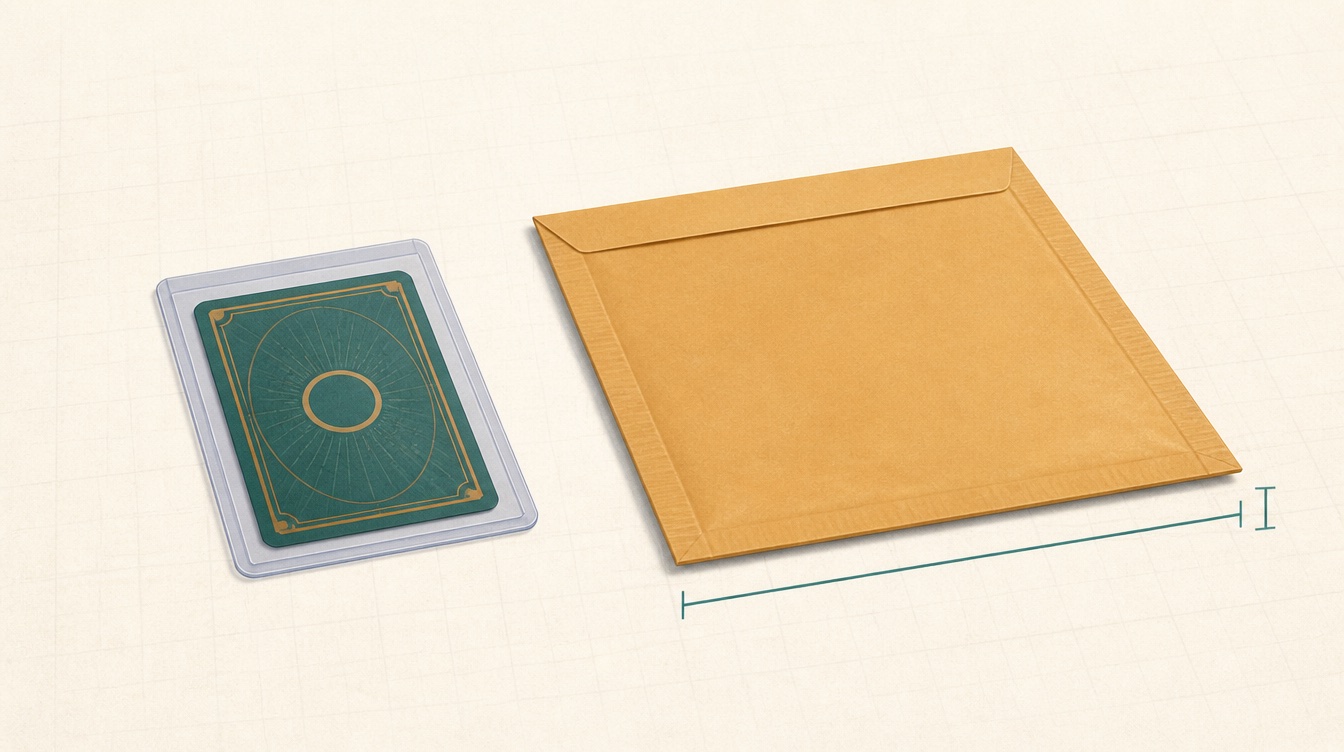
eBay standard envelope is a shipping level built for small, light items sent in a plain envelope instead of a padded mailer or a box. It isn't limited to trading cards. Sellers use it for stickers, patches, thin jewelry, phone cases, anything flat and low value. For card sellers specifically, it has become the default way to move a single loose card cheaply while still getting tracking on the shipment.
The program works by trading flexibility for cost. eBay negotiates a discounted rate for a narrow category of mail: light, thin, non-rigid items that sorting equipment can handle the same way it handles letters. Step outside that lane, too heavy, too thick, or too stiff, and the package either won't generate a label at the discounted rate or risks getting flagged somewhere in the mail stream. That tradeoff is the whole story: the low cost only holds if the shipment stays inside the program's limits.
What the program actually covers
- Declared item value. eBay caps how much the item can be worth to qualify; check the program's current threshold before you list, since shipping and tax don't count toward that number and the cap itself gets revised.
- Weight. The package needs to stay at or under about 3 ounces.
- Thickness. The envelope has to lie flat everywhere, roughly a quarter inch (about 6mm) at its thickest point, with no rigid lumps inside.
- Envelope size. The mailer itself has to fall in a set size range, from a small business envelope up to roughly a 6x9in booklet envelope.
- Slabs and rigid holders. Graded cards in a plastic slab don't qualify at all. They're too thick and too rigid for the sorting equipment this class depends on.
Confirm the current figures on eBay's own shipping page before you build a listing habit around them. These are the numbers we found current as of this writing, and eBay revises program terms without much fanfare.
Will your card setup fit?
The card itself barely registers against that 6mm cap. What pushes a package over the line is what you wrap around it.
| Setup | What adds up | Reads as rigid? | Fits the program |
|---|---|---|---|
| Raw or penny-sleeved card | Card is 0.305mm thick; a soft sleeve adds almost nothing | No | Yes, comfortably under the cap |
| Semi-rigid holder | Thin, but stiffer than a soft sleeve by design | Semi-rigid | Borderline; measure the actual stack before you commit to it |
| 35pt toploader | Rated to hold 35pt of card, which works out to about 0.035in (0.9mm), before counting the toploader's own plastic shell | Yes | No, the rigid shell is usually the disqualifier, not the thickness math |
A 1pt rating is one thousandth of an inch, which is why a "35pt" toploader sounds thin on paper. That number describes card capacity, not the finished package, and it says nothing about rigidity. eBay's rule isn't only about thickness; it's about whether the item stays flexible enough to move through the same equipment as a letter. A toploader fails that test even when the math looks fine. Our toploader size chart has the full pt-to-inch breakdown if you're comparing thicknesses for a different shipping class.
What we'd actually ship this way
A single common or a low-value card in a penny sleeve is exactly what this program was built for. It costs close to the price of a stamp, and the sleeve keeps the card from sliding around without adding measurable bulk. We ship those in a plain standard envelope without thinking twice.
We get more careful the moment a toploader enters the picture. It's tempting to want that extra rigidity for a card you're proud to have pulled, but a toploader is a rigid piece of plastic and this program exists for flat, floppy mail. Tape the edges to stop the card shifting inside and you've likely pushed past the thickness limit too, on top of the rigidity problem you already had. If a card feels valuable enough to want a toploader, it's usually valuable enough to sit above the program's value cap anyway, which settles the question either way. See do sleeved cards fit in toploaders for the fuller case on when the rigidity is worth it and when a sleeve alone does the job.
Semi-rigid holders are the one case worth actually checking rather than guessing. If a holder lies flat and thin in your hand with no spring to it, it's probably fine for this program. If it has any curl or resistance when you flex it, size up to a tracked plain envelope instead.
Our own line: under the value cap and in a sleeve alone, standard envelope every time. Above the cap, or once a toploader or slab is involved, a tracked envelope with rigid backing or a padded mailer is the honest call, and our toploaders page is a fine place to pick the holder for that heavier shipment. A little extra postage beats explaining to a buyer why their card arrived with a bent corner.
Quick answers
Does a toploader fit in an eBay standard envelope? Not reliably. The program is built for flat, non-rigid mail, and a toploader's plastic shell is rigid by design, so even a thin one risks being flagged regardless of how the thickness math works out. A penny sleeve is the safer default for this shipping class.
What happens if my package doesn't meet the requirements? The label either won't generate at the discounted rate, or the shipment risks getting kicked back somewhere in the mail stream. Don't try to force a borderline package through; move up to a tracked plain envelope or a padded mailer instead.
Is this the same thing as a plain envelope with a stamp? No. It's a specific eBay-run program with its own label, its own discounted rate, and its own eligibility rules, separate from buying regular postage and dropping a card in an envelope yourself.
The appeal is real: a card can ship for close to the price of a stamp and still carry tracking. That only holds up if the package respects the caps instead of testing them, and a card that's borderline on value or thickness is exactly the shipment where the cheap option turns into a headache.