Guides Traveling with multiple decksCases built to carry more than one deck at once, drawn from our measured data, plus the packing habits that actually protect cards on a real trip.Read
  Ultra Pro Satin Tower: what it really holdsUltra Pro Satin Tower capacity checked against its real 76mm interior depth, including why it's the community default for double-sleeved Commander decks.Read
  Boxes that carry two decksThe closest thing to a true two-deck box in our data is Ultimate Guard's Twin Flip'n'Tray line. Here's what it actually holds, and where the numbers run out.Read
  Sidewinder vs Boulder: side load or top load?Ultimate Guard Sidewinder and Boulder compared by interior depth and real double-sleeve fit, and why side-loading wins for a snug 100-card deck.Read
 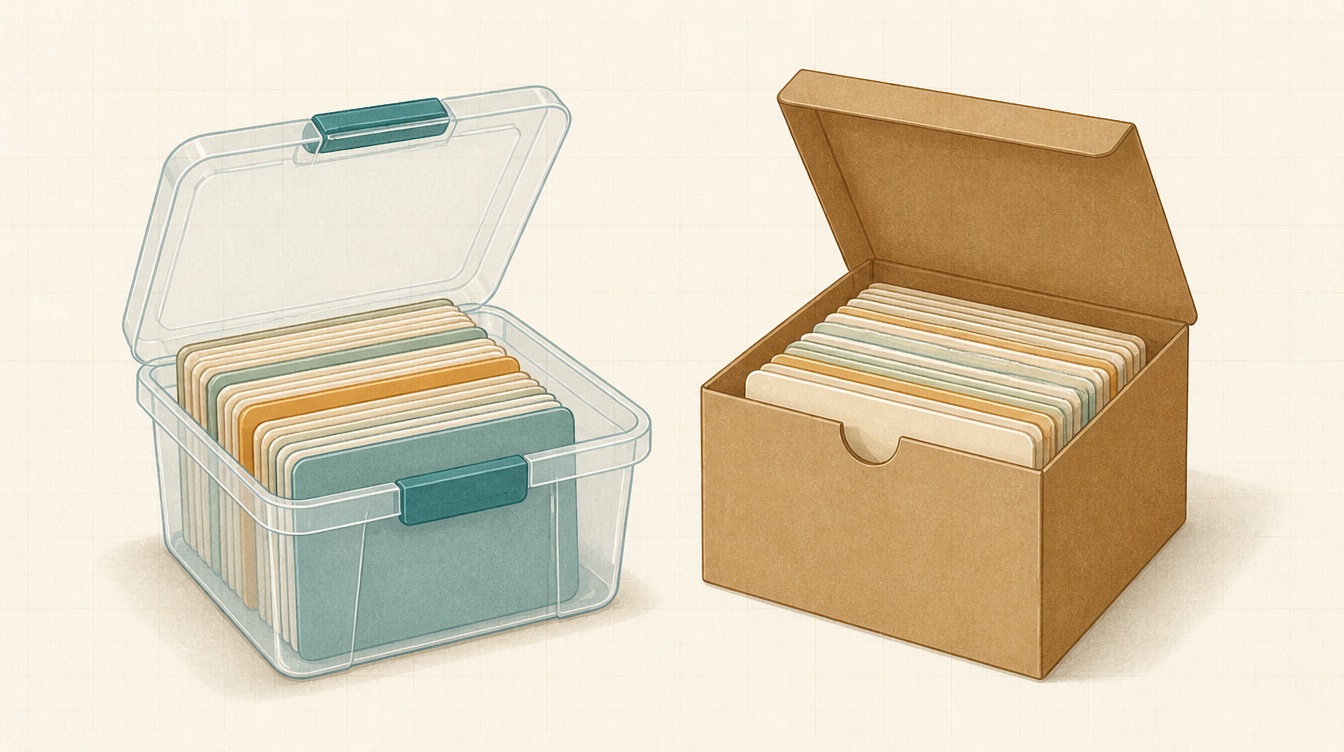 Plastic bins vs cardboard boxes for cardsCardboard is cheaper and fine in a stable room. Plastic bins cost more but hold their shape and shrug off spills. Here's when each one earns its spot.Read
  Magnetic vs friction deck boxesA magnetic clasp and a friction lid close a deck box differently. Here's how each holds up under a full sleeved stack, with one confirmed magnetic pick.Read
  Is a premium deck box worth it?Premium deck boxes buy magnetic latches and convertible trays, not automatically more interior room. The measurements say what your money actually gets.Read
 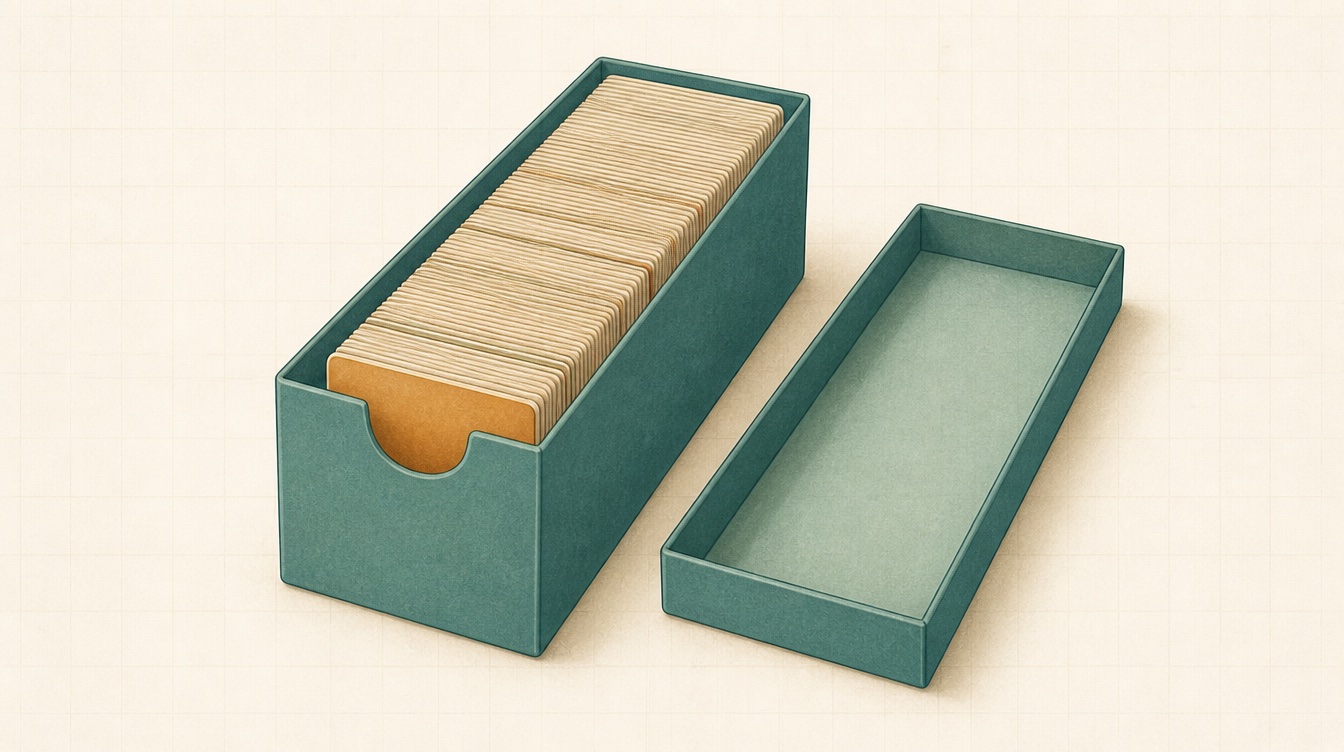 Storing bulk Magic cards: what actually worksCardboard count boxes still win for true bulk Magic and MTG cards; here's the full storage ladder plus a comparison of every 400 to 2,200-card box.Read
 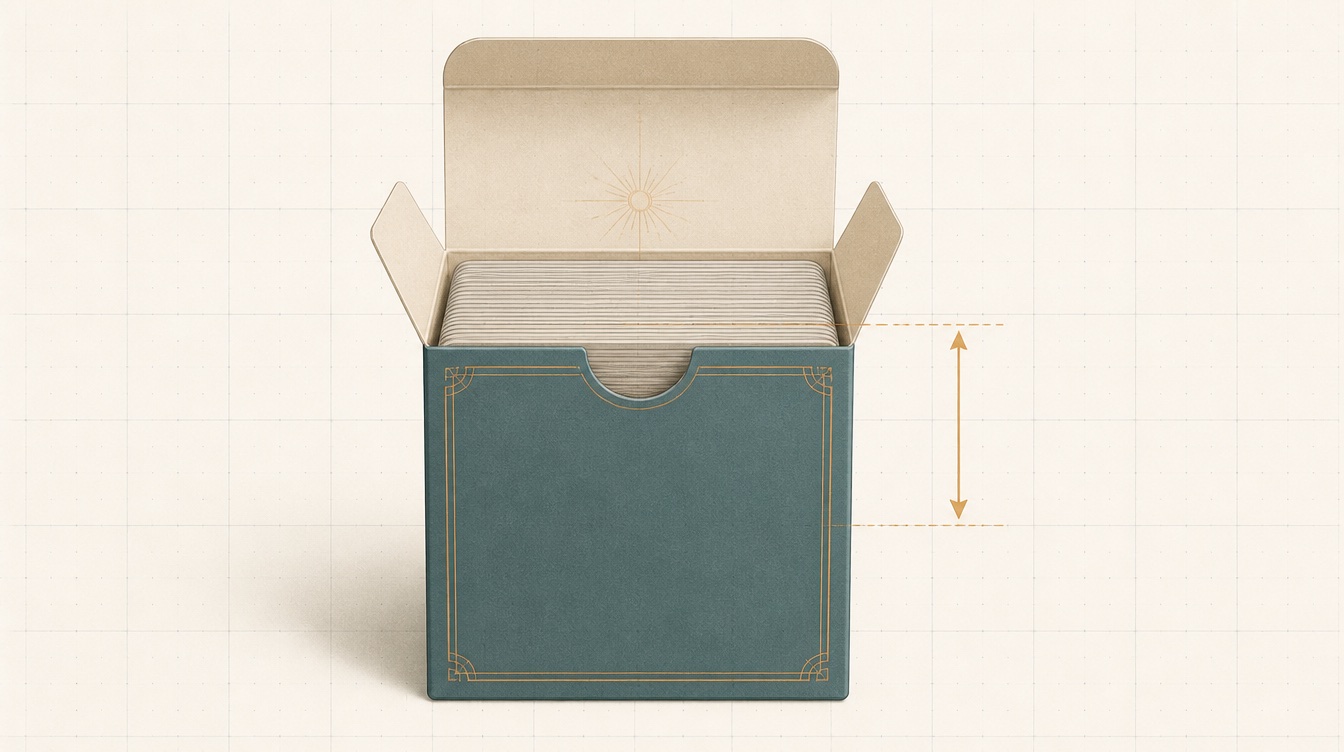 How many unsleeved cards fit in a deck box?A standard card is 0.305mm thick, so 100 stack to 30.5mm. Here's the raw thickness math and why real deck boxes fall short of the theoretical max.Read
 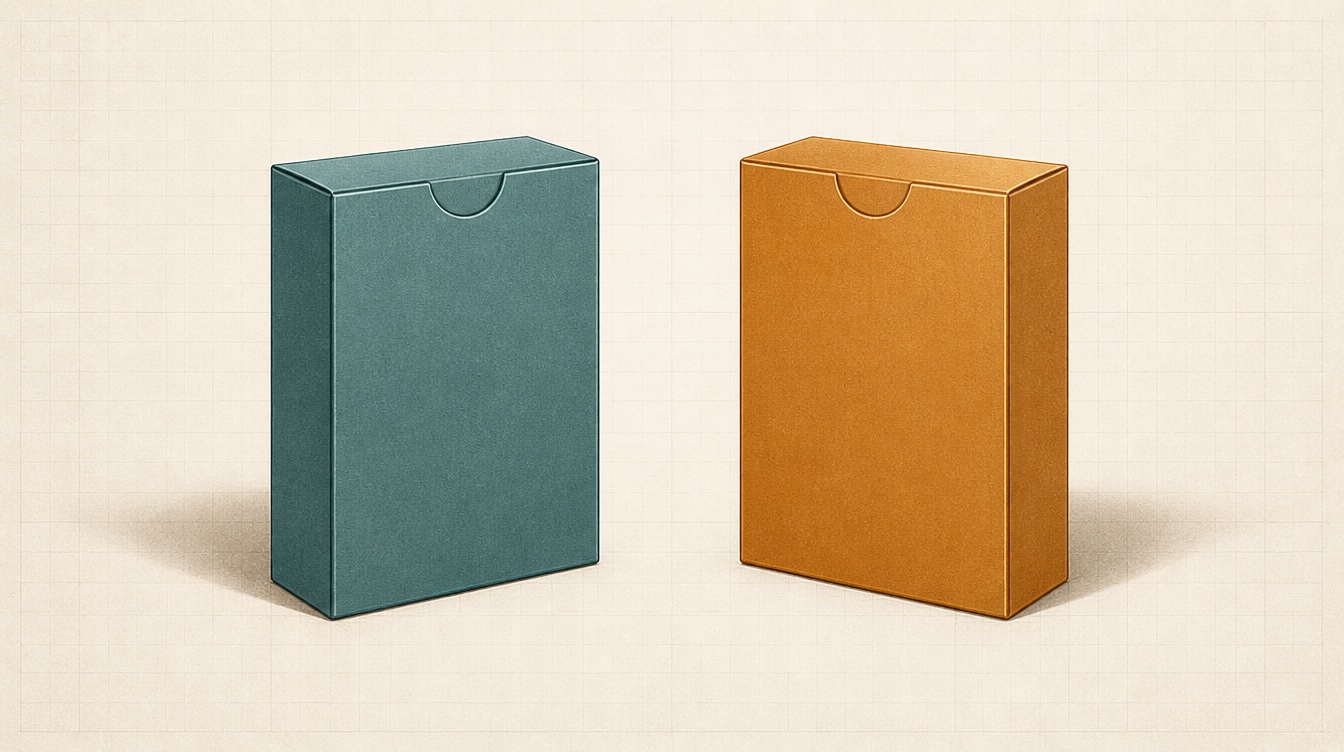 Gamegenic vs Ultimate GuardNo single winner between Gamegenic and Ultimate Guard deck boxes. The measurements say who wins by use case, from basic 100 count to bulk storage.Read
 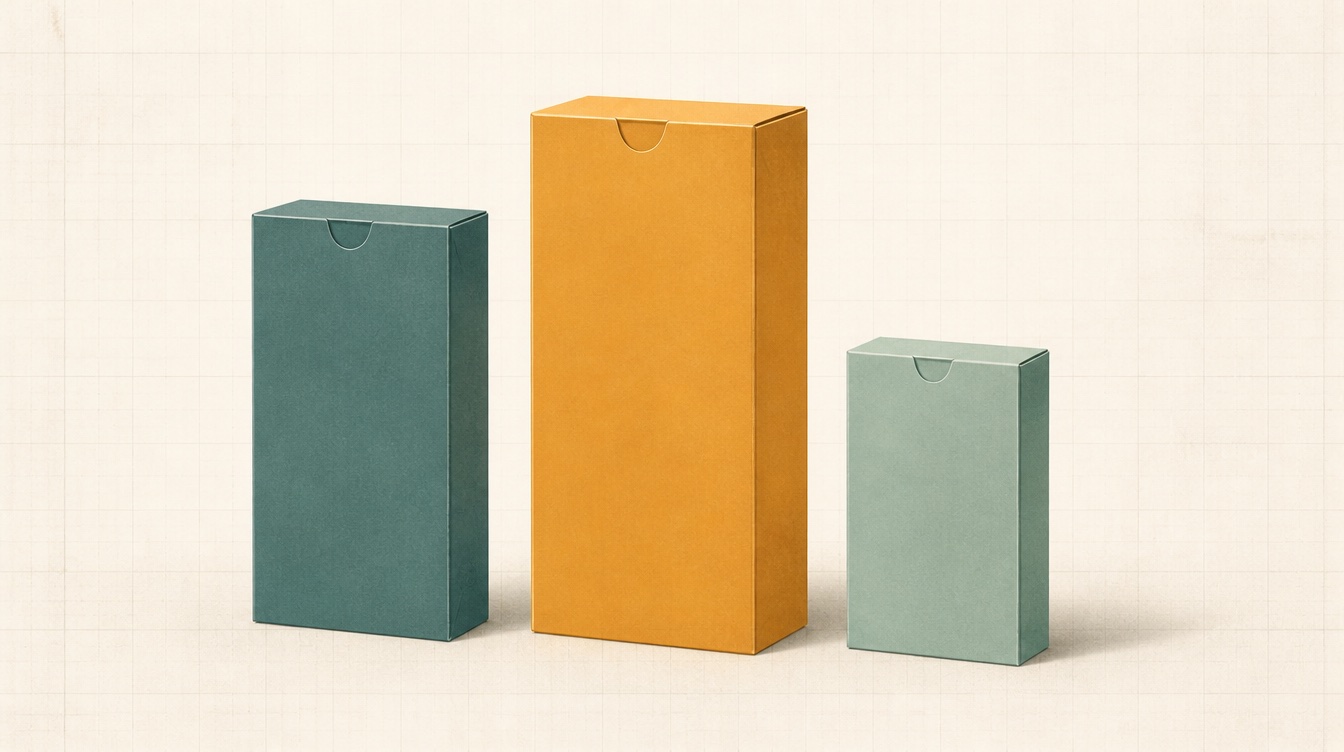 Gamegenic Bastion vs Watchtower vs SquireGamegenic's Bastion, Watchtower, and Squire 100+ deck boxes compared on interior depth and the XL fit problem the non-XL versions run into.Read
  Why your deck box won't close (and what to do)A deck box that won't close with sleeved cards usually comes down to sleeve thickness, air pockets, or a real card count mismatch. Fixes in order of cost.Read
 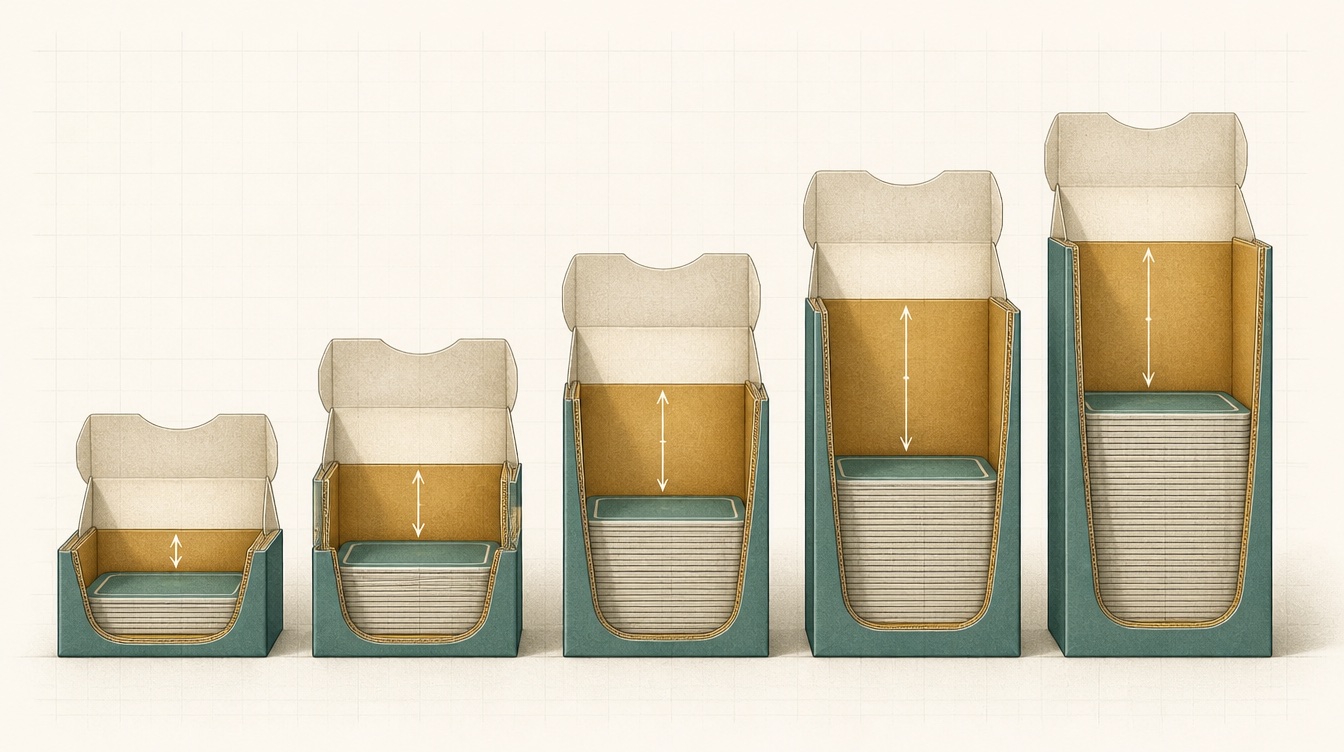 Deck box interior depths, one big chartEvery deck box in our data with a documented interior depth, sorted smallest to largest, from a snug 55mm to a cavernous 90mm. Real numbers only.Read
  Deck boxes for Yu-Gi-Oh: main, extra, sideYu-Gi-Oh needs a box for a 40-60 card main deck plus room for a 15-card extra and side deck. Here's how to size each one using real capacity ratings.Read
  Deck boxes for a 60-card Pokemon deckA 60-card Pokemon deck only needs a handful of confirmed picks. Here's which boxes are sized for exactly that, and which are worth the extra room.Read
 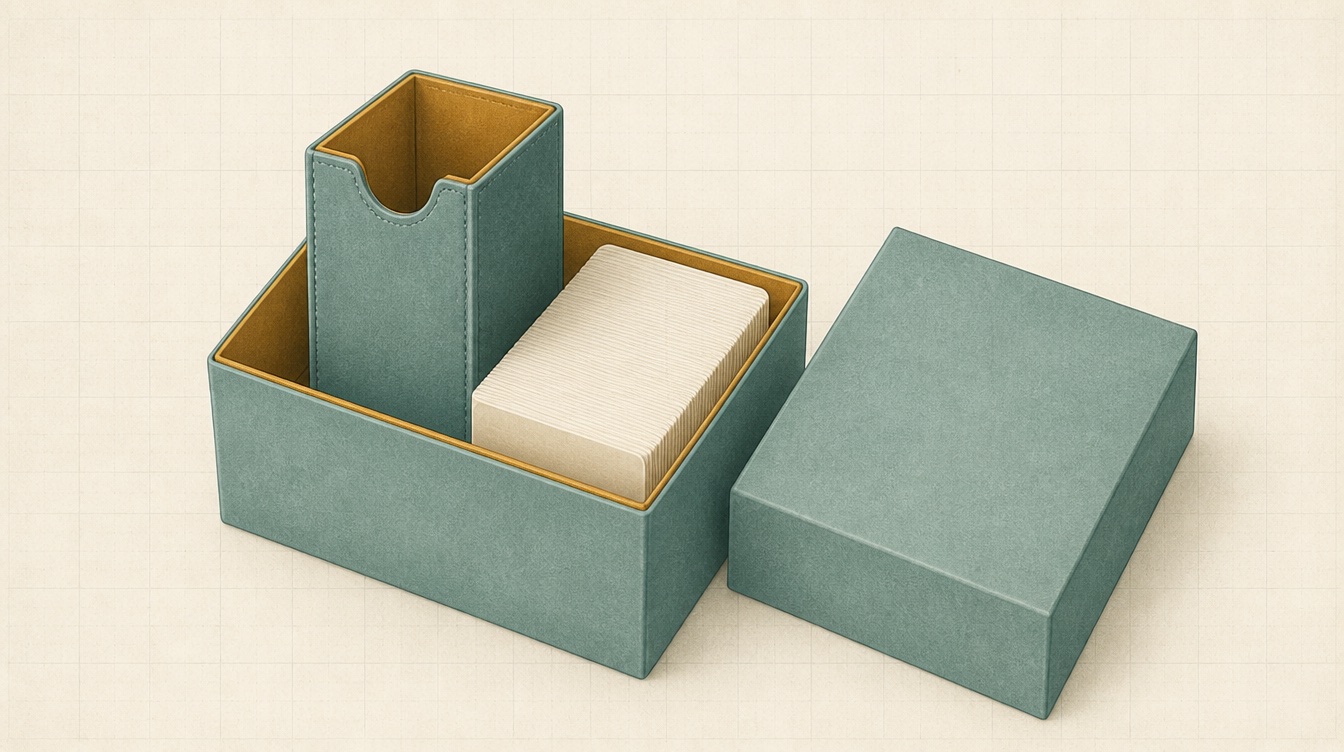 Deck boxes that fit a toploaderMost single-deck 100 count boxes are sized for a sleeved card, not a rigid toploader. A few flip-top, tower, and bulk boxes have the room; here's the honest list.Read
  Commander deck boxes with room for diceThree deck boxes built with genuine room for dice and tokens alongside a 100 card Commander deck, plus what our data can't confirm about tray sizes.Read
  Cheap deck boxes that still closeA handful of budget deck boxes hold a full sleeved deck without a fight. The priciest textured box isn't always the roomiest one inside.Read
  Boulder 100+ vs Dragon Shield Nest 100Ultimate Guard Boulder 100+ and Dragon Shield Nest 100 compared on real interior depth and double-sleeve fit, with a verdict for single and double sleeved decks.Read
 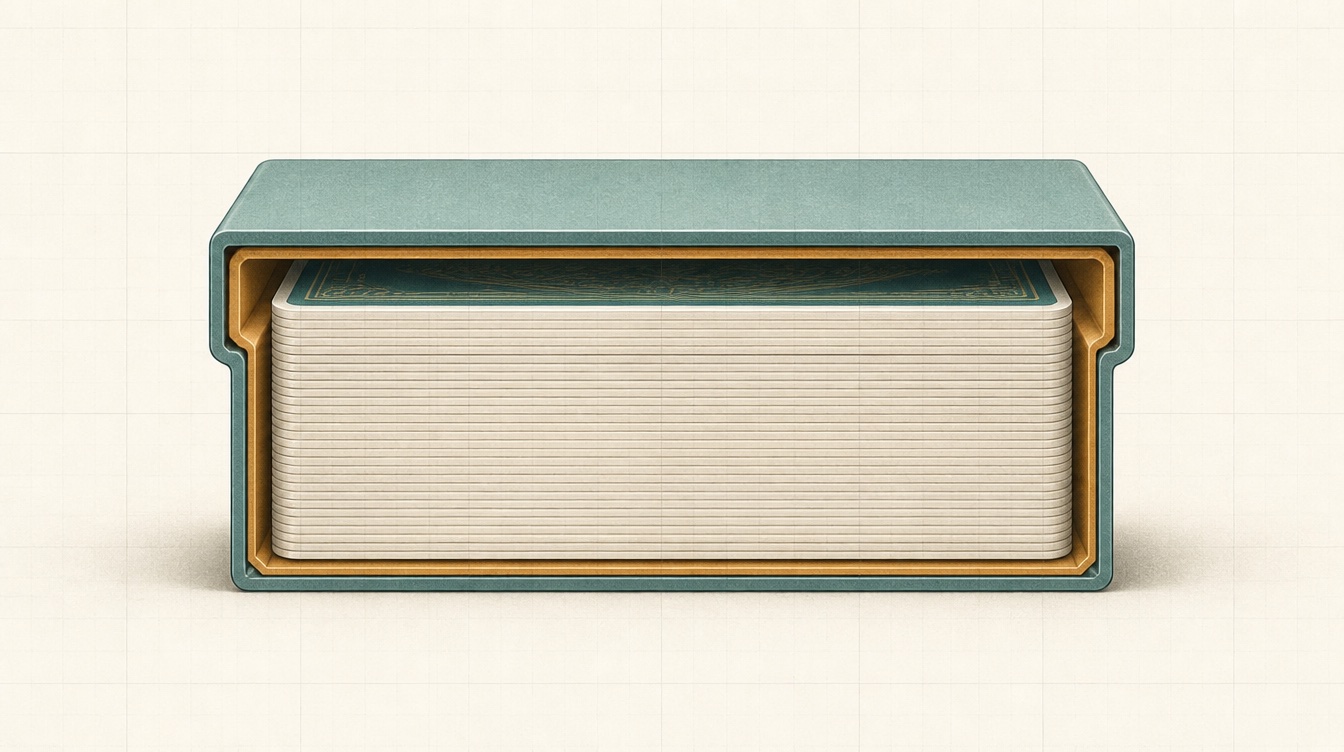 Deck boxes that actually close on a double sleeved deckA double sleeved deck won't fit just anywhere. Here's why closure type and interior depth matter more than the sticker, and where to find verified fits.Read
  The best deck box for Commander, by the numbersSeven deck boxes that verifiably hold 100 double sleeved cards, ranked by interior depth, with the tightest and roomiest picks called out plainly.Read
 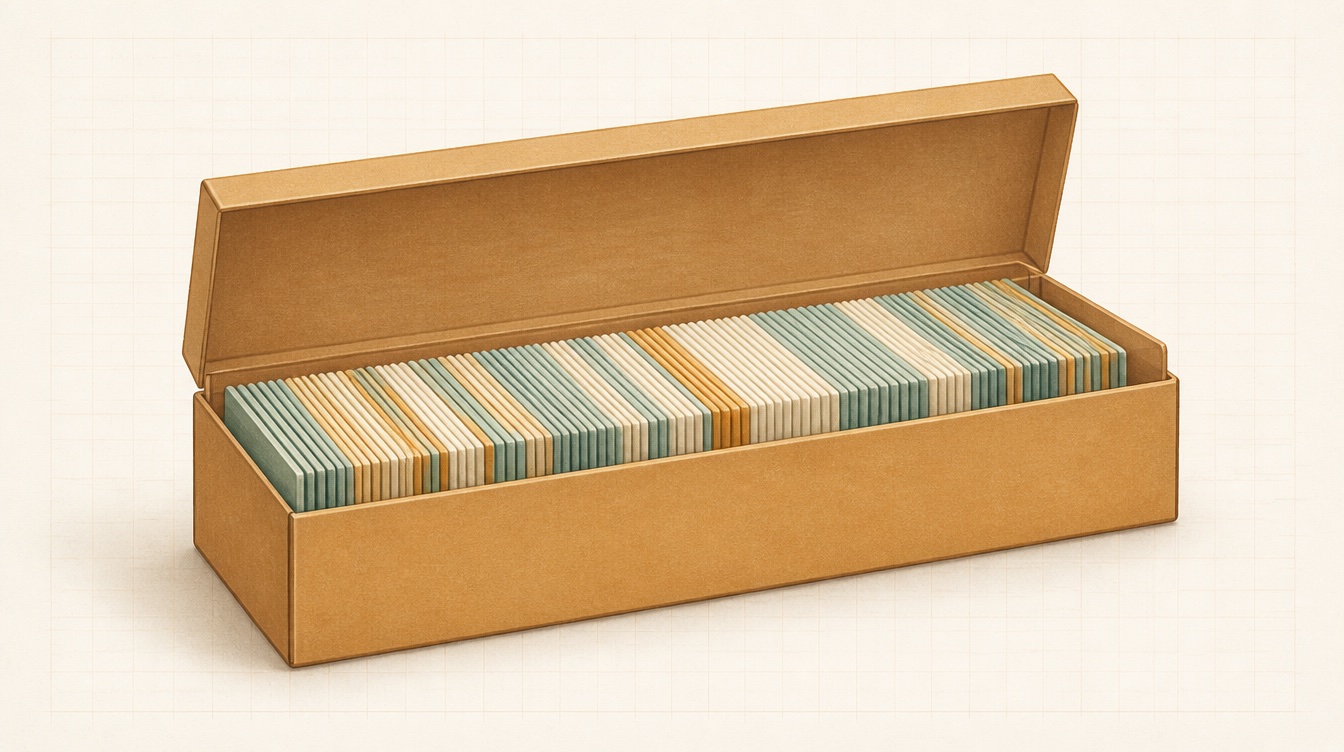 What an 800-count box really holdsAn 800-count box is rated for raw, unsleeved cards. Here's the actual math on card thickness, and how far that number drops once cards are sleeved.Read
  Ultimate Guard Boulder sizes, decodedEvery Ultimate Guard Boulder size compared by stated capacity and interior depth, plus why the Boulder 100+ struggles with double-sleeved Dragon Shields.Read
  What does 100+ actually mean on a deck box?"100+" is a manufacturer capacity claim tested with one sleeve combo, not a promise for yours. Real examples of boxes that pass, fail, or sit tight.Read
 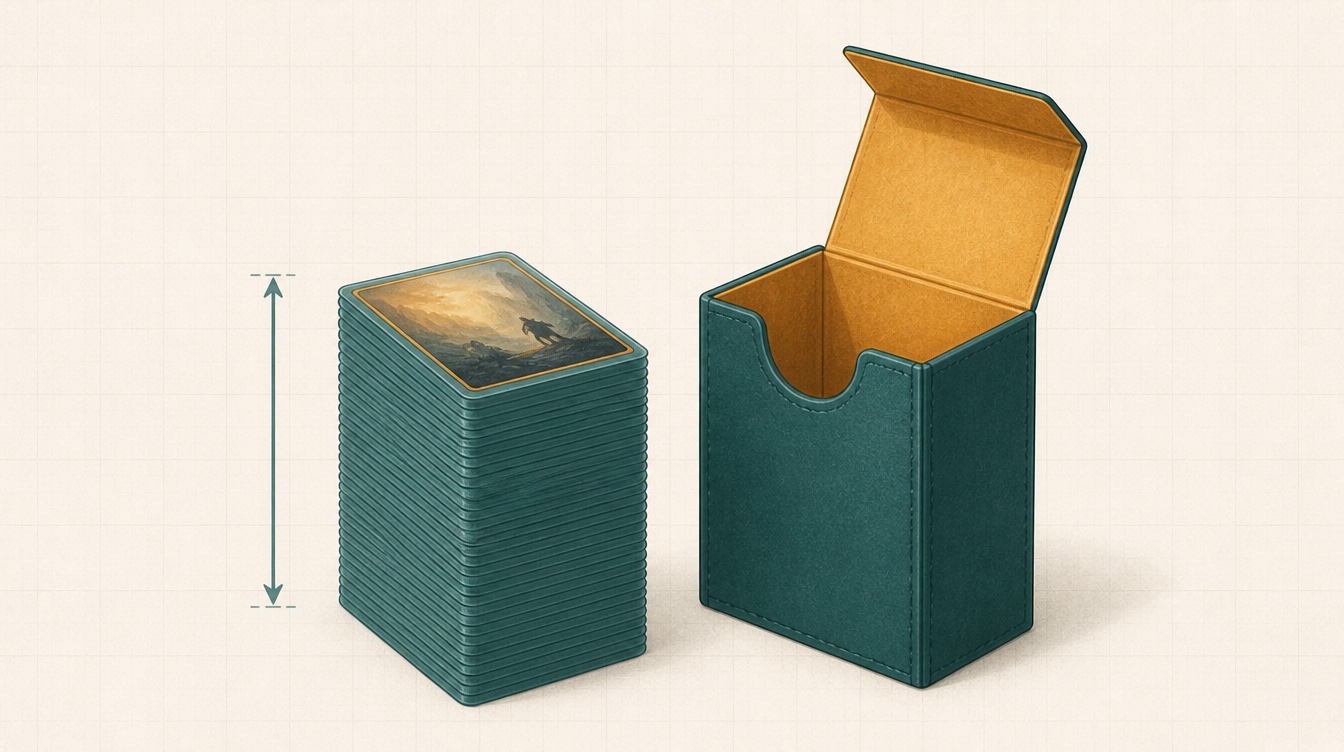 How many double sleeved cards fit in a deck box?The real math behind "100+": card thickness plus two sleeve layers, stack height versus interior depth, and a worked example using measured combos.Read
 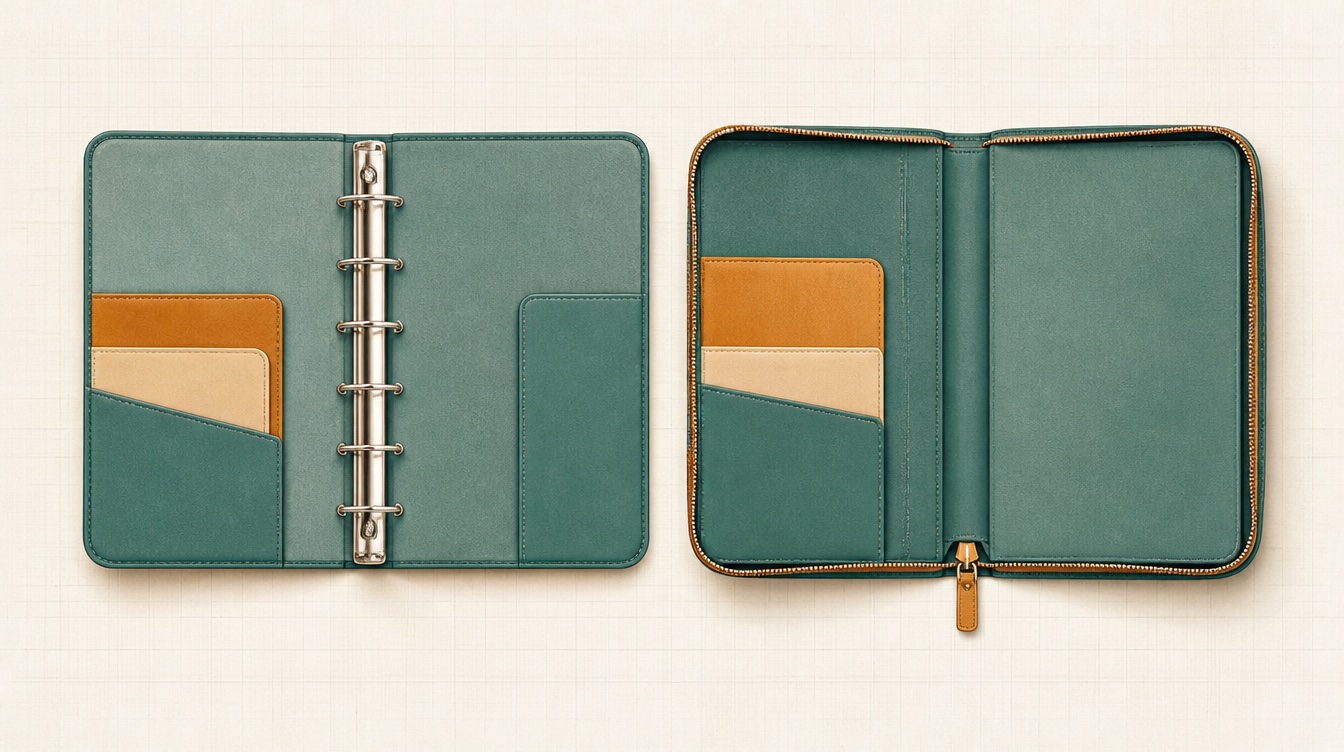 Ring binder or zip binder?A zip binder ships as one fixed-capacity book. A ring binder is a cover you load pages into yourself, up to a stated ceiling. Here's the real math.Read
  Do binders damage cards?A binder doesn't damage cards on its own, but the wrong page material, overstuffing, or storing it flat under weight can. Here's what actually causes it.Read
 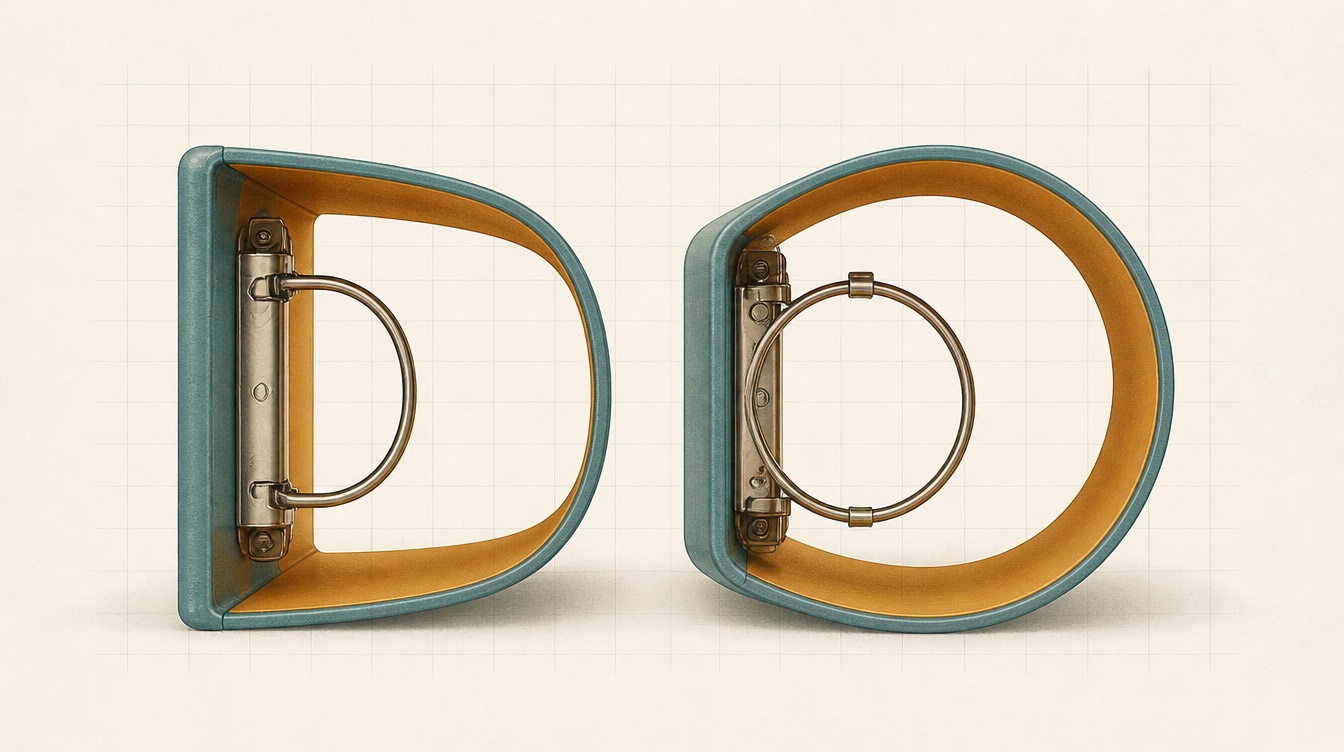 D-ring vs O-ring bindersO-rings are round and let pages bow and drift. D-rings sit flat against the spine, keeping pages stacked evenly and cutting long-term card dent risk.Read
  Binders for One Piece and LorcanaOne Piece and Disney Lorcana both use the 63x88mm standard card size, so any standard binder in our data holds either one without a fit problem.Read
 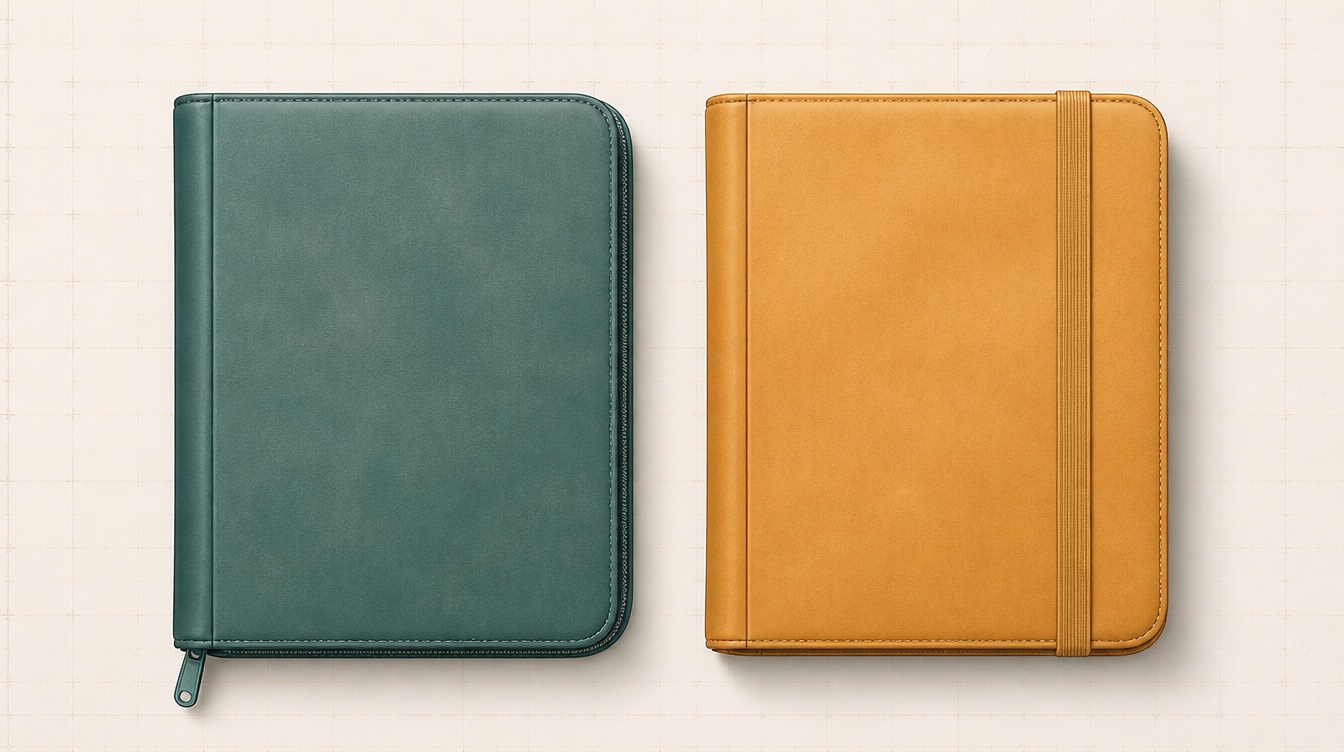 Zip binder vs strap binder: the real trade-offVault X sells the same binder in zip and strap versions at matching capacities, which isolates the closure question. Here's what actually changes.Read
 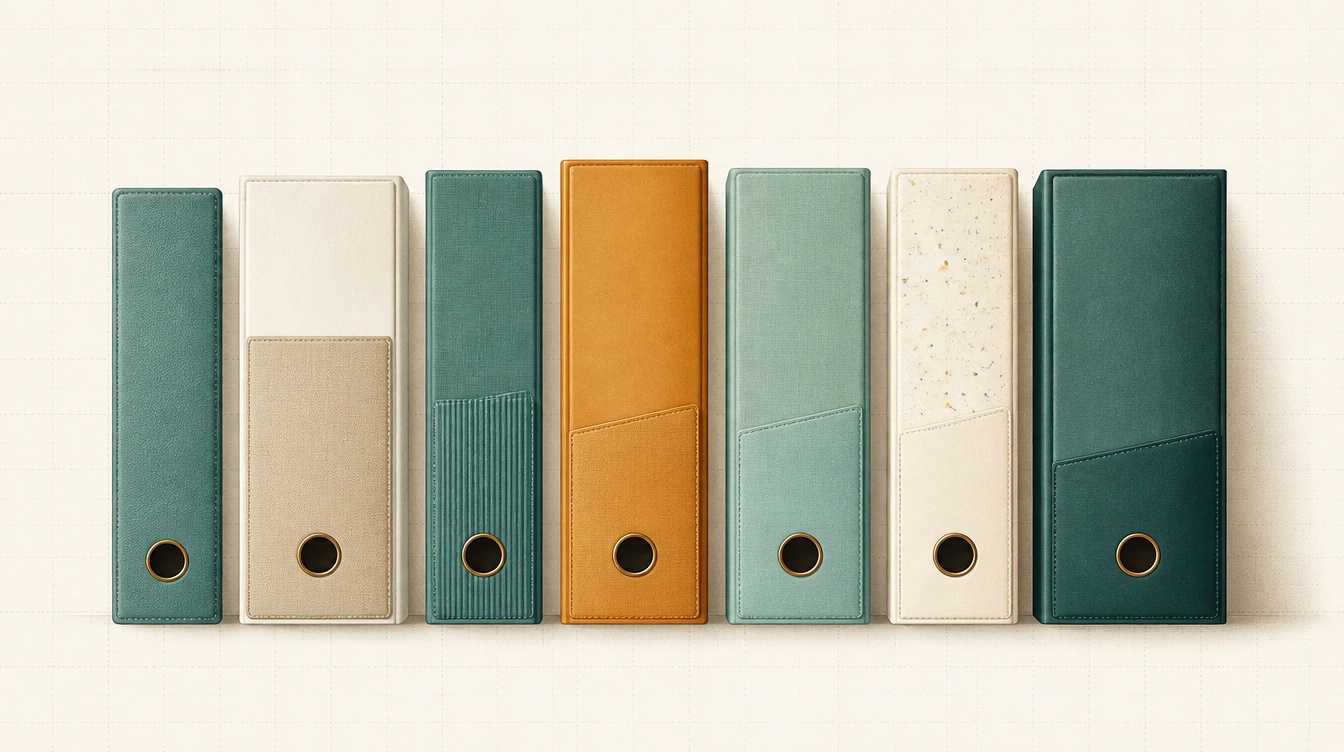 Vault X binder sizes: 160 to 1,088 cards comparedCompare Vault X Exo-Tec zip binder capacity, dimensions and pocket size. See what XL and XXL change, and why these pockets do not fit 3×4 toploaders.Read
 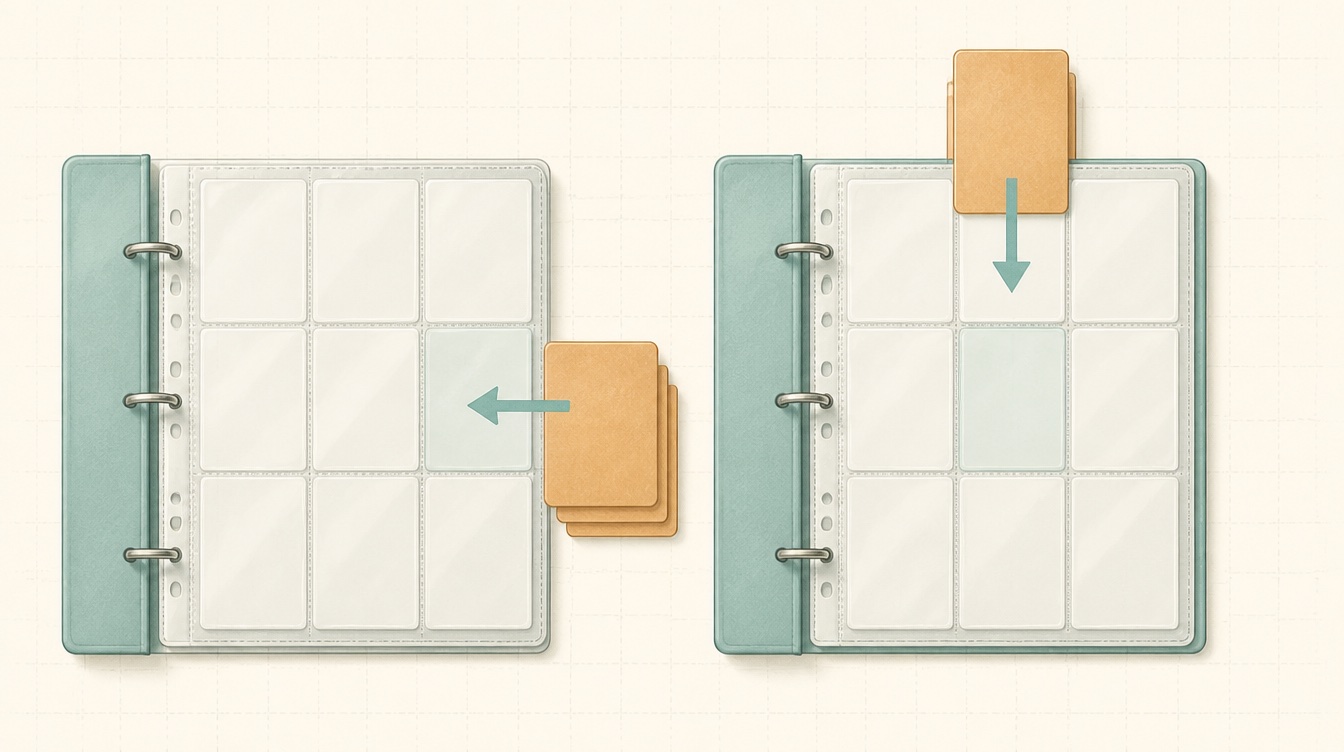 Side loading vs top loading binders, settledSide loading won the binder page format war years ago. Every binder we track, all 39 of them, opens on the side edge instead of the top. Here's why.Read
  How many cards fit in a binder?The math is pockets per page times two sides times page count. A standard 9 pocket binder holds 360 cards, but toploader pages hold far fewer cards.Read
 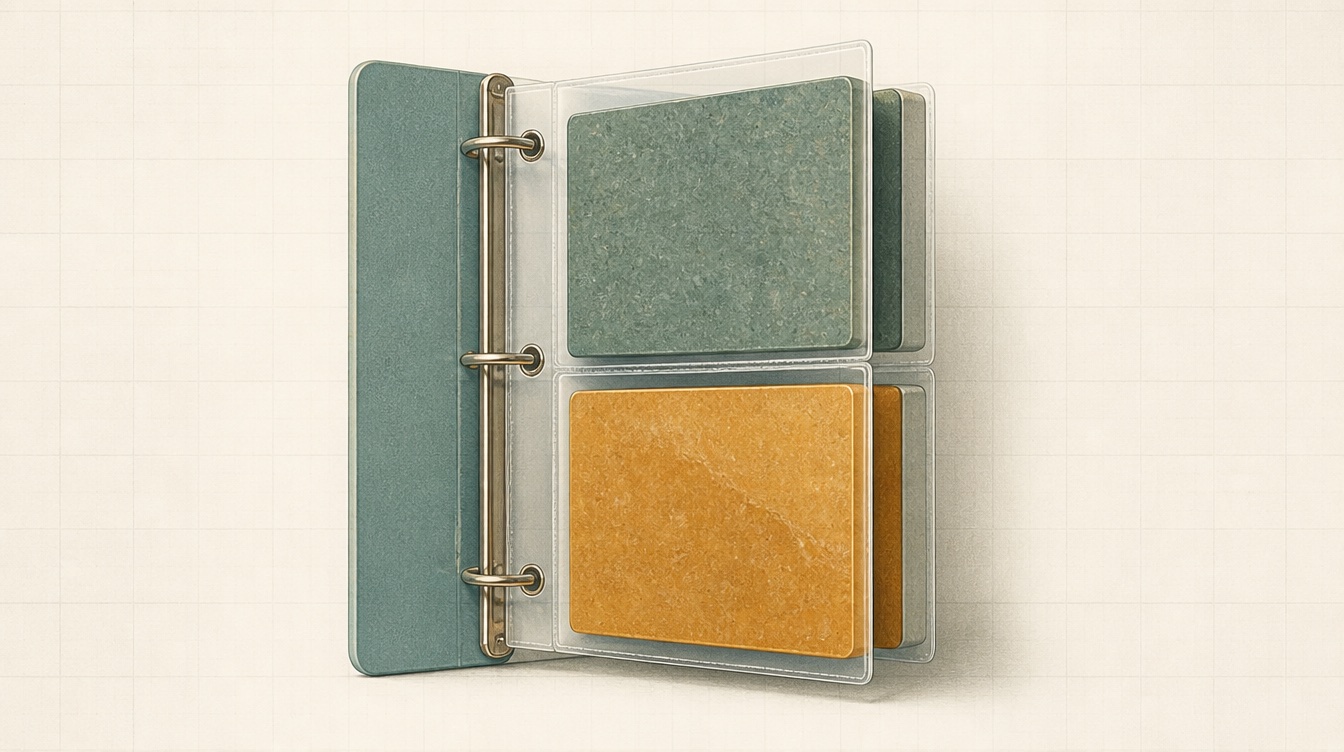 Binders for graded slabsStandard 9-pocket binder pages don't fit graded slabs at all. Here's why the pocket math fails and what a slab actually needs from a binder.Read
 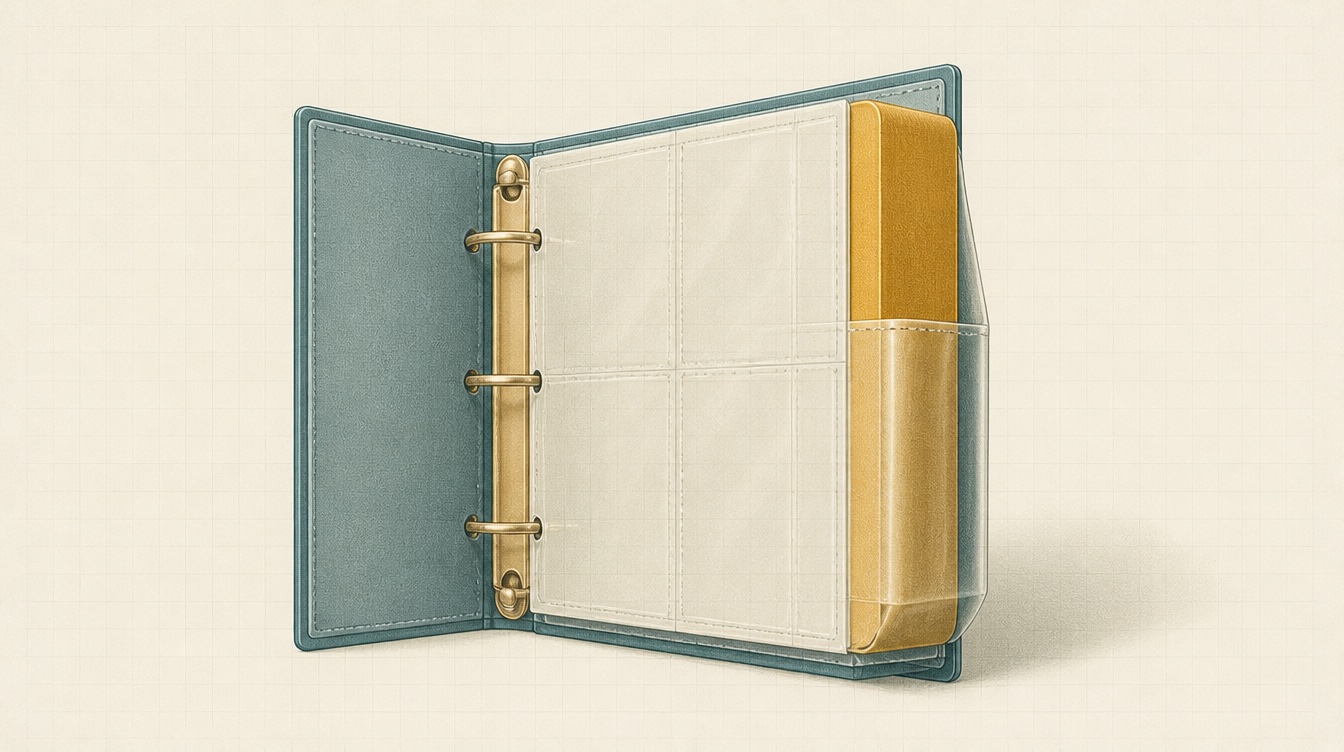 Binders that fit toploaders: all 3 comparedBCW, TopDeck, and Gemloader all make a binder that fits a toploader. Same pocket count, same closure, different page count, here's how they stack up.Read
 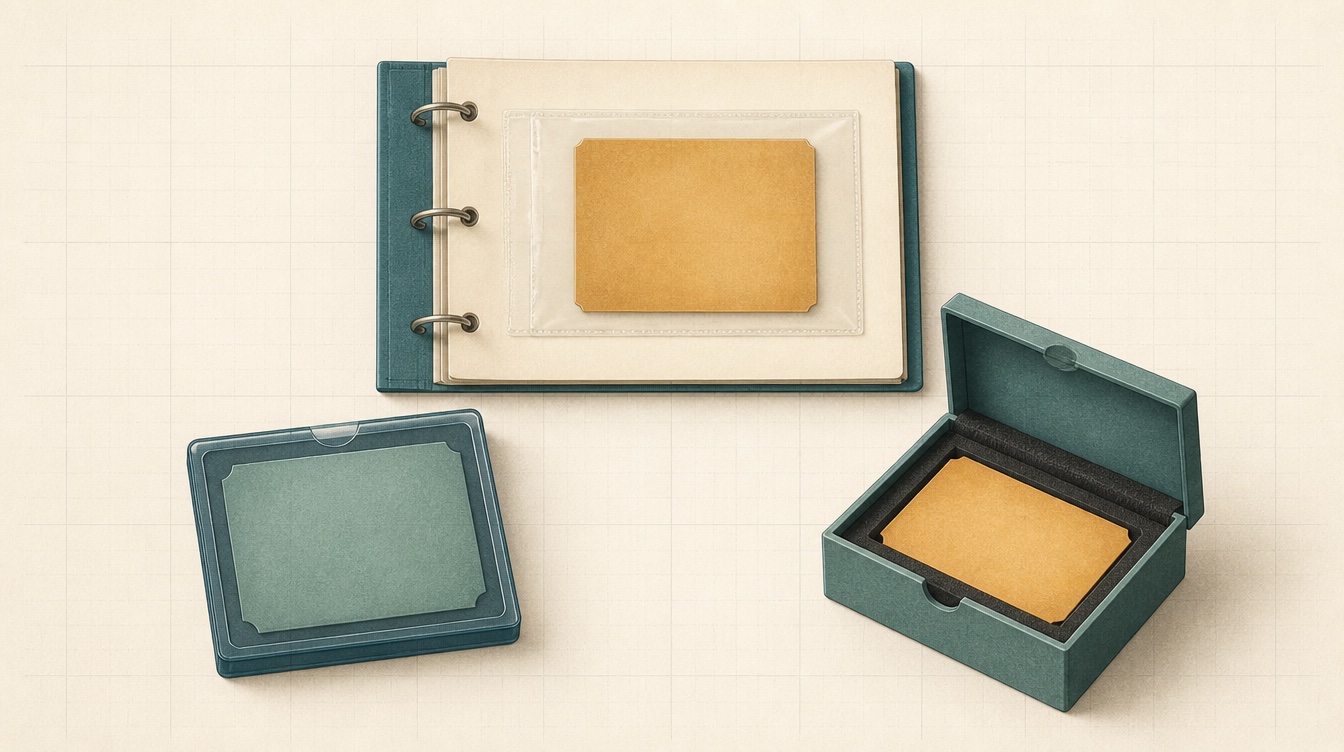 Binder, toploader, or box? Where each card goesMatch the container to how you use the card, not just its value. A played deck goes in a box, a single valuable card in a toploader, the rest in a binder.Read
 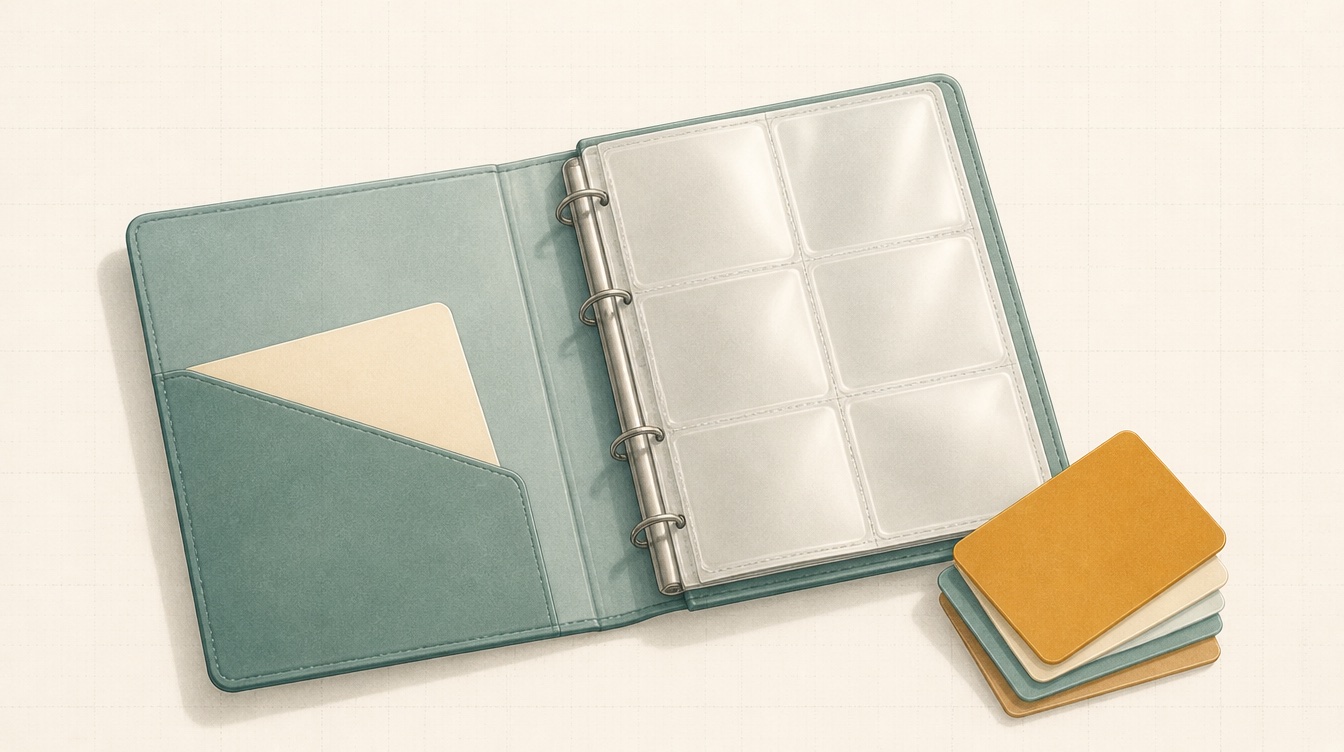 Best binder for Pokemon cards: what we'd buyOur binder picks for Pokemon collections, everyday, big, toploader, and budget, plus the one binder that holds over 1,000 cards in a single book.Read
 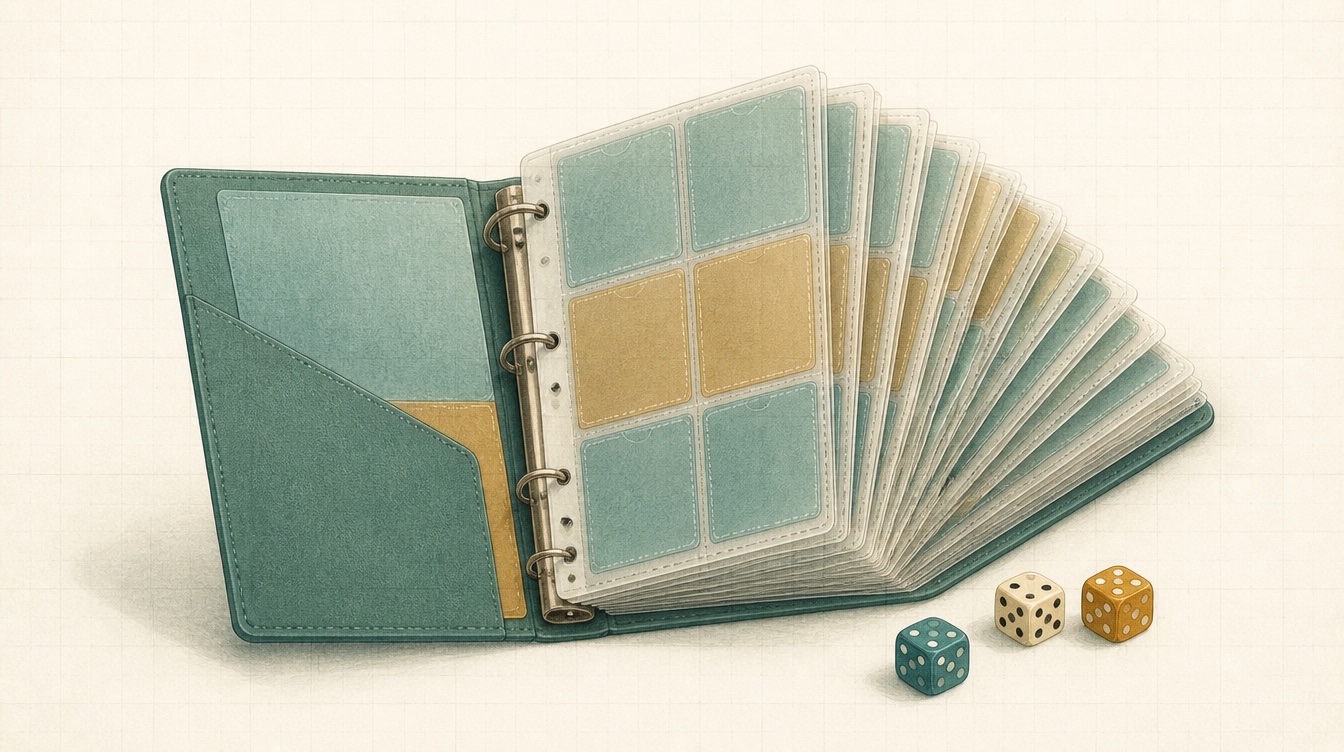 The best binder for a Magic collectionA trade binder and a collection binder solve different problems. Here are the standout picks for each job, with real pocket and capacity numbers.Read
 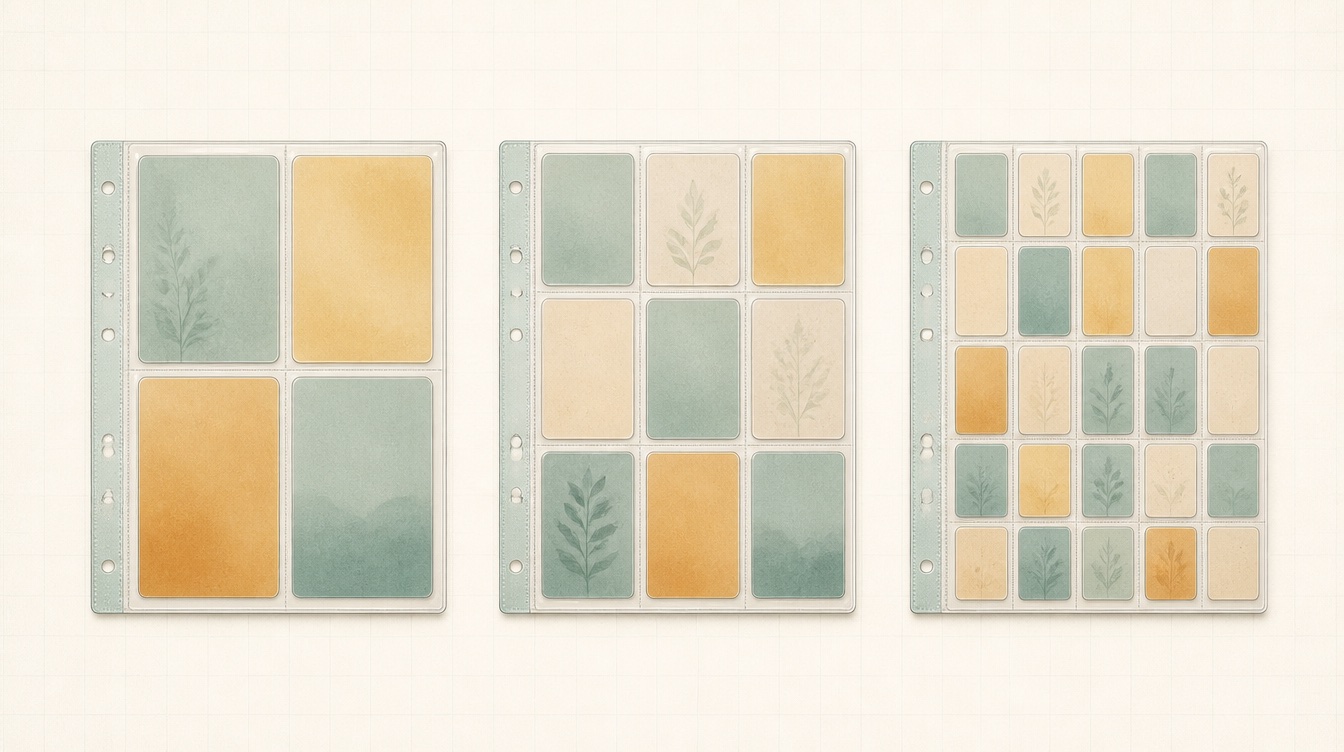 4, 9, or 12 pocket binder?A 4-pocket page gives each card more room to breathe. A 12-pocket page packs in more total cards per binder. Here's the real capacity tradeoff, with numbers.Read
  Binders that take double sleeved cardsMost binder pockets handle double sleeved cards without a fight, since they flex instead of hitting a rigid depth wall. Here's what our data confirms.Read
 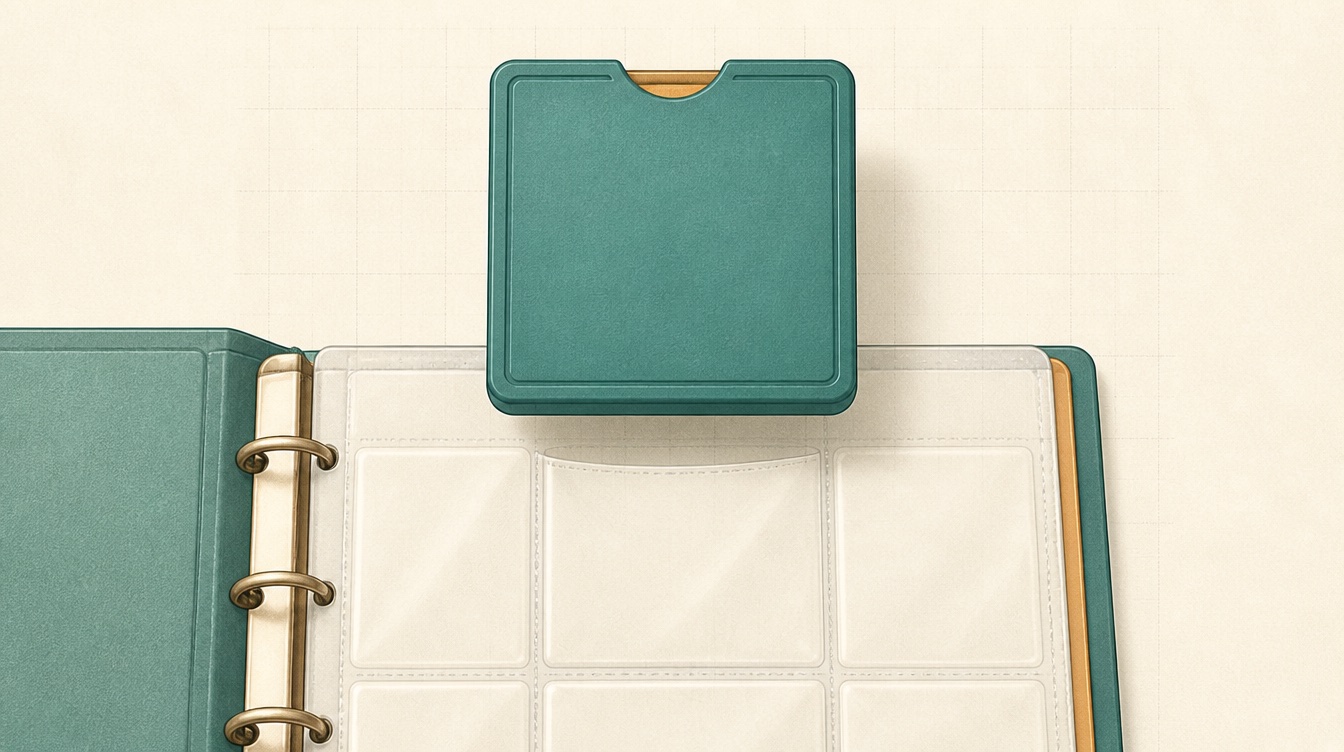 Do toploaders fit in binders? Sizes and compatible modelsA 3×4 toploader is too large for a standard sleeved-card pocket. Compare the dimensions and see manufacturer-listed binders made for rigid holders.Read
 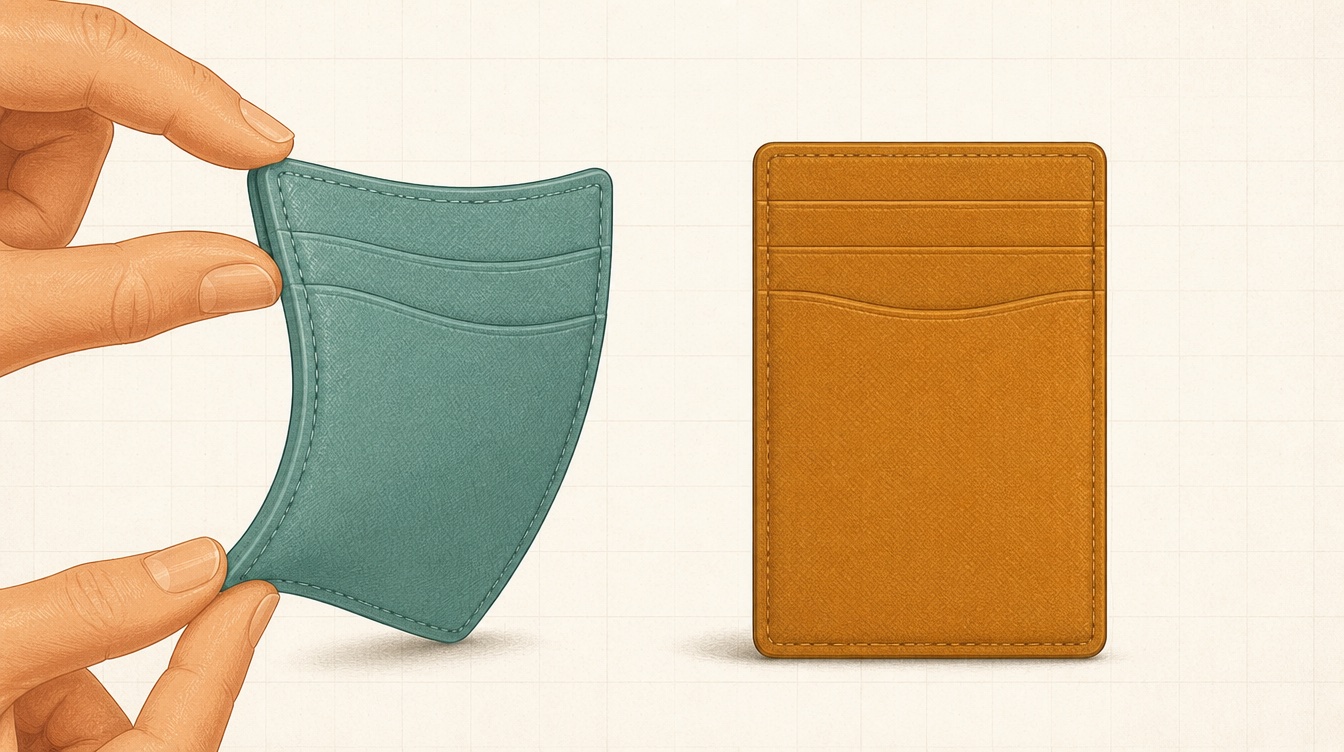 Semi-rigid holders: when floppy beats rigidA semi-rigid holder bends instead of cracking, which is exactly what grading submissions want. A rigid toploader still wins for everyday storage and shipping.Read
  PWE vs tracked: the seller mathThe right shipping method is risk times value, not habit. Here's the seller math for when a plain envelope is fine and when tracking earns its cost.Read
 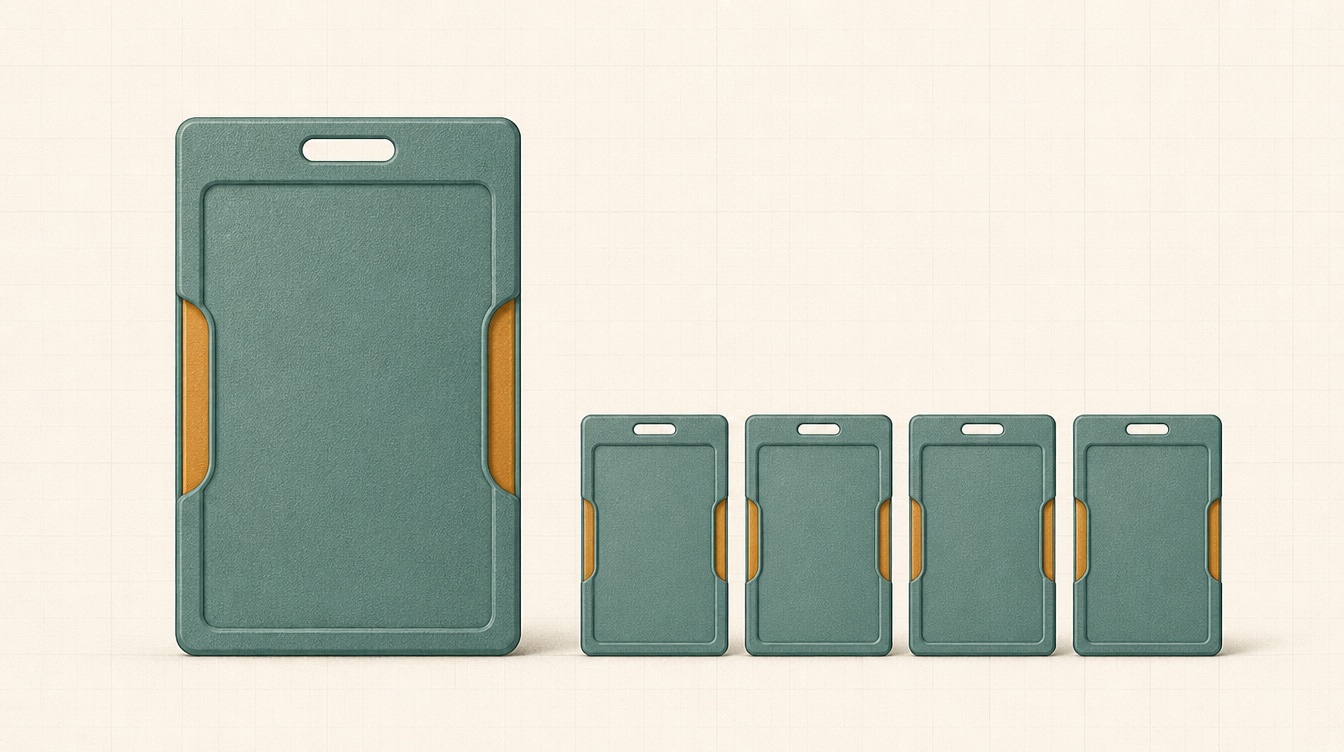 Toploaders for jumbo and oversized cardsStandard toploaders don't fit jumbo promos or oversized cards. Here's what those formats actually run, and how to buy a holder that fits without guessing.Read
 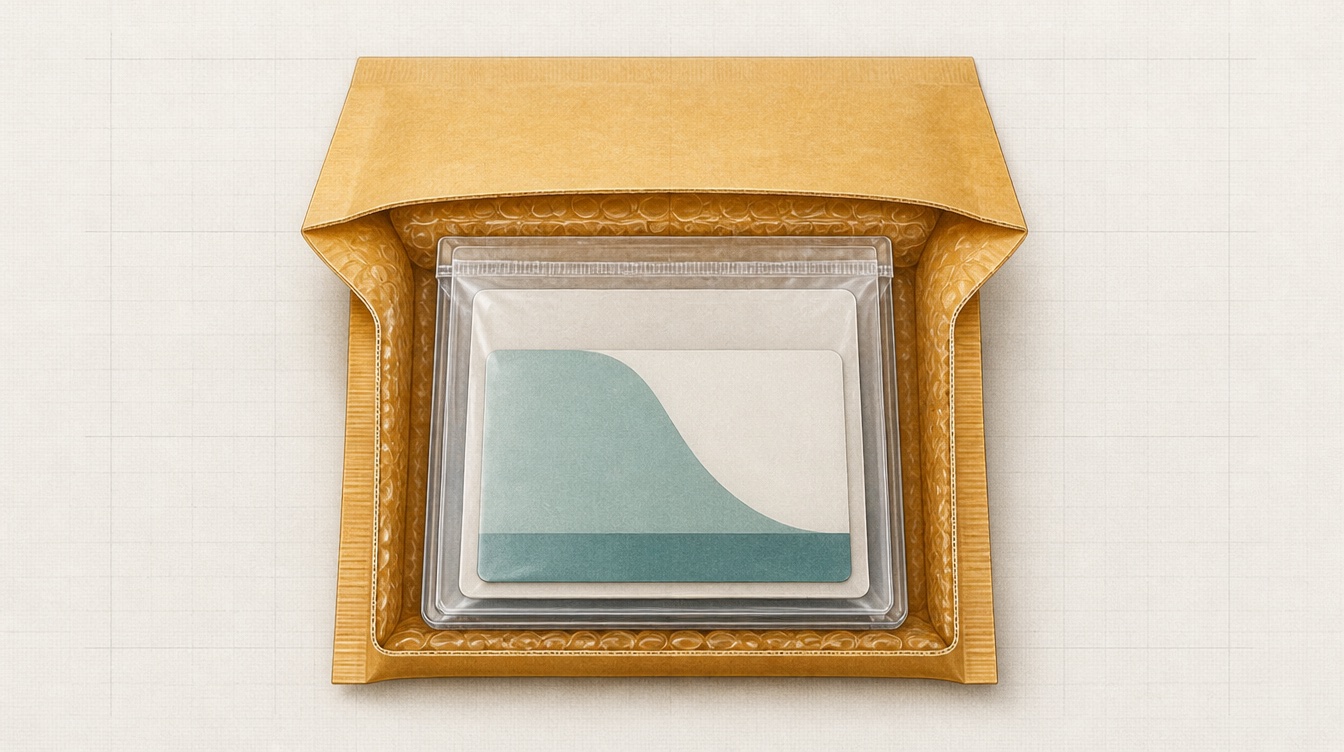 What size bubble mailer for trading cards?A 4x8 bubble mailer fits one sleeved, toploadered card with room for rigid backing. Bigger cards, stacks, and slabs need to size up from there.Read
  What does 35pt mean on a toploader?Pt stands for points, a unit equal to one thousandth of an inch. A 35pt toploader is rated to hold about 0.89mm of card thickness, not width or height.Read
 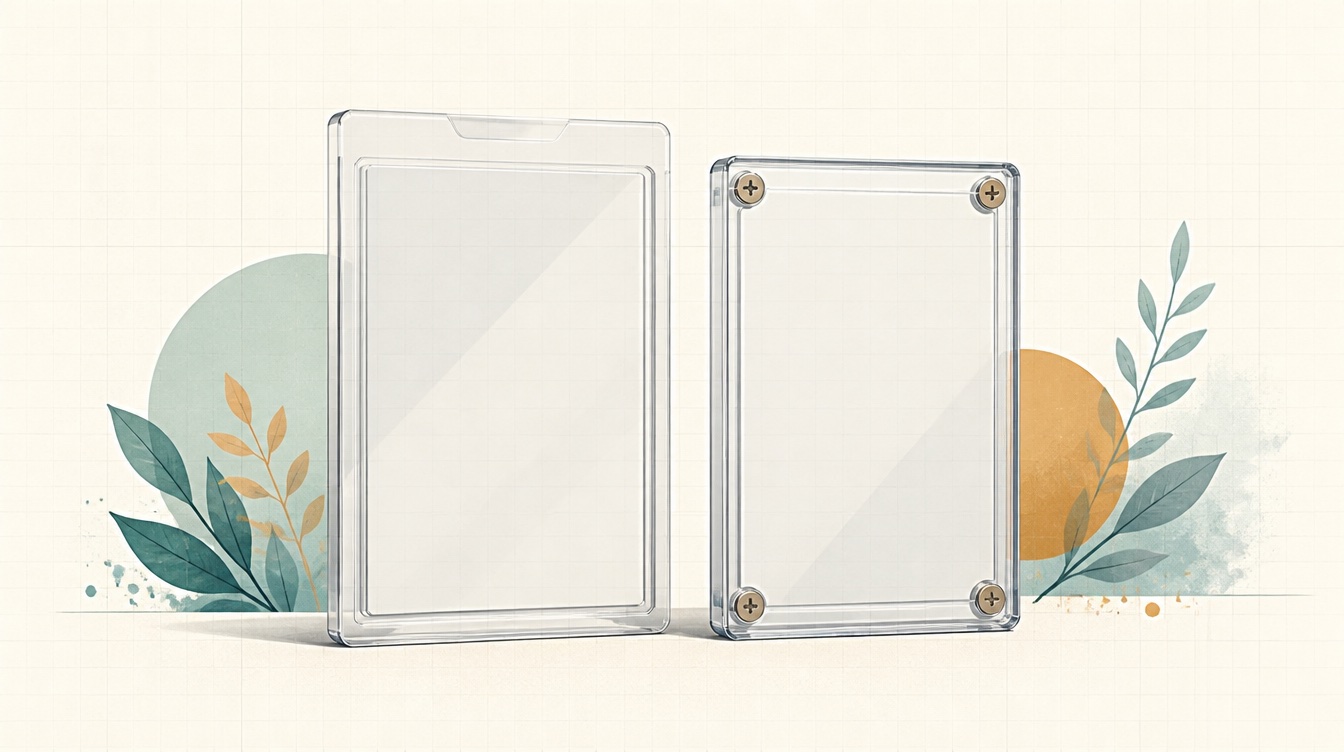 Toploader vs One-Touch: which protects better?A toploader is an open-top slide-in sleeve; a One-Touch closes with magnets. Same pt sizing, different jobs, one built for bulk and one built for display.Read
 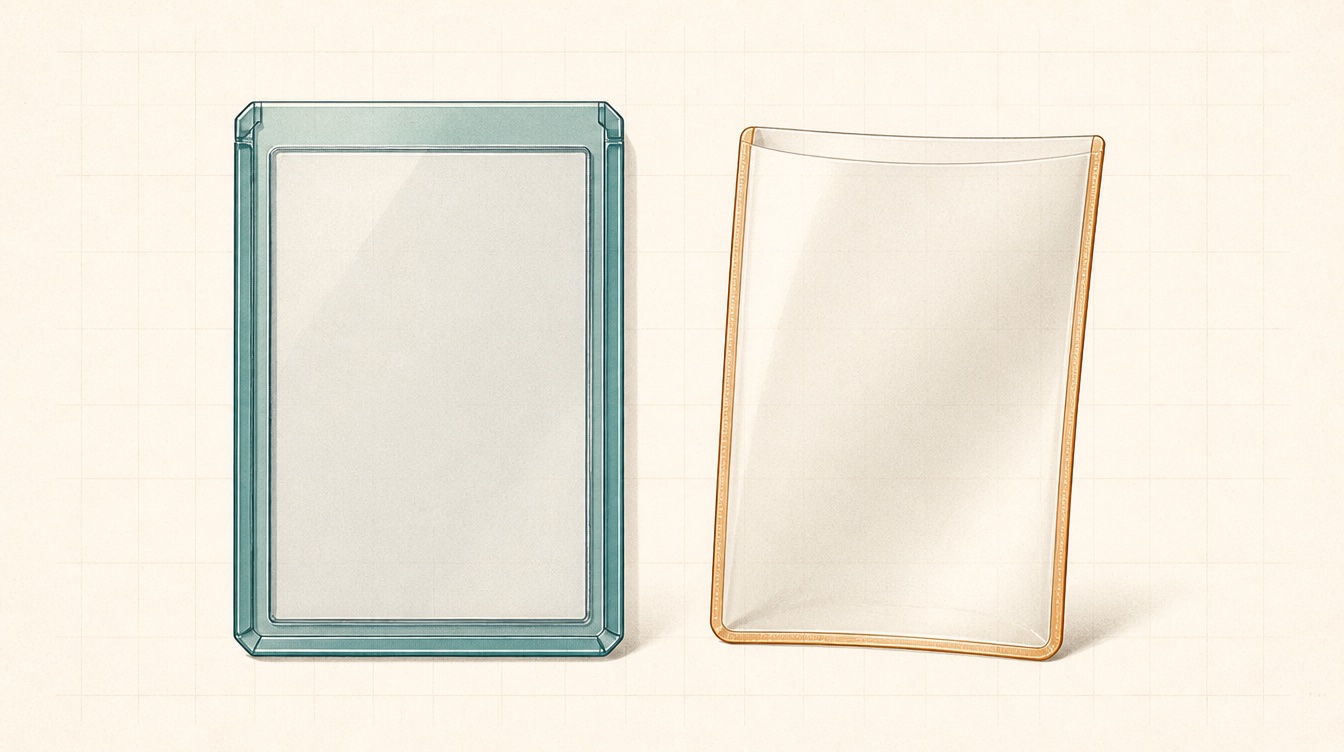 Toploader vs Card SaverA toploader is rigid plastic; a card saver is a thin, semi-rigid sleeve that flexes. For everyday storage either works, but grading has a real answer.Read
  What toploader fits thick Pokemon cards?Most V, VMAX, and full-art Pokemon cards need a 55pt toploader, not 35pt. Here's how to match the pt size to the card type, and when to size up again.Read
  Shipping cards internationallyInternational card shipping needs a customs form and a tracked tier picked by value. The sleeve, toploader, and seal stack underneath stays exactly the same.Read
  What holders PSA actually wantsPSA asks for each card in a sleeve inside a semi-rigid holder like Card Saver 1, not a rigid toploader. Here's what's accepted, what gets rejected, and why.Read
  One-Touch sizes, from 35pt upOne-Touch magnetic holders use the same pt scale as toploaders, 35 through 180pt in our data. What each size holds, and why the ladder has fewer steps.Read
 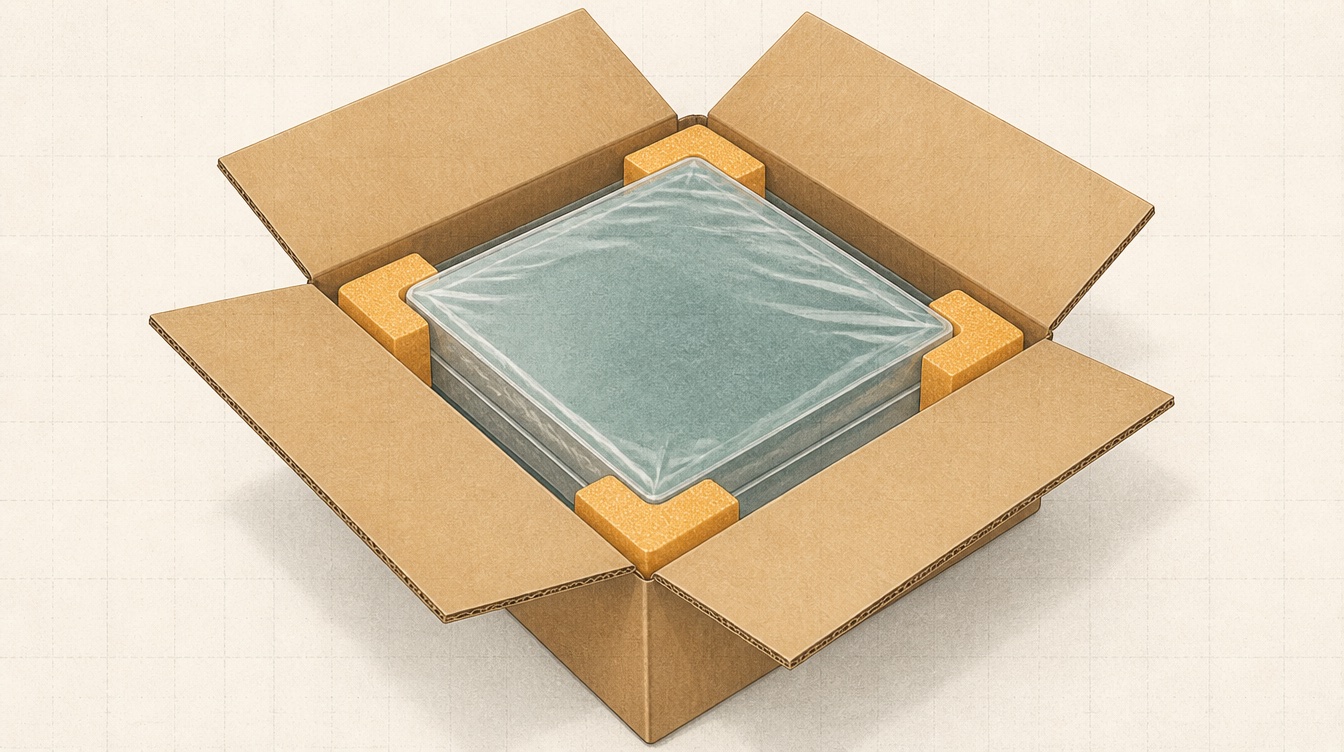 How to ship graded slabs safelyA graded slab's case is the fragile part, not the card. Ship it in a box, not an envelope, with padding on all six sides so a corner impact can't crack it.Read
  How to ship a single trading cardSleeve, toploader, then a team bag or tape to seal it, then a PWE or bubble mailer by value. The full shipping stack and why each layer earns its place.Read
 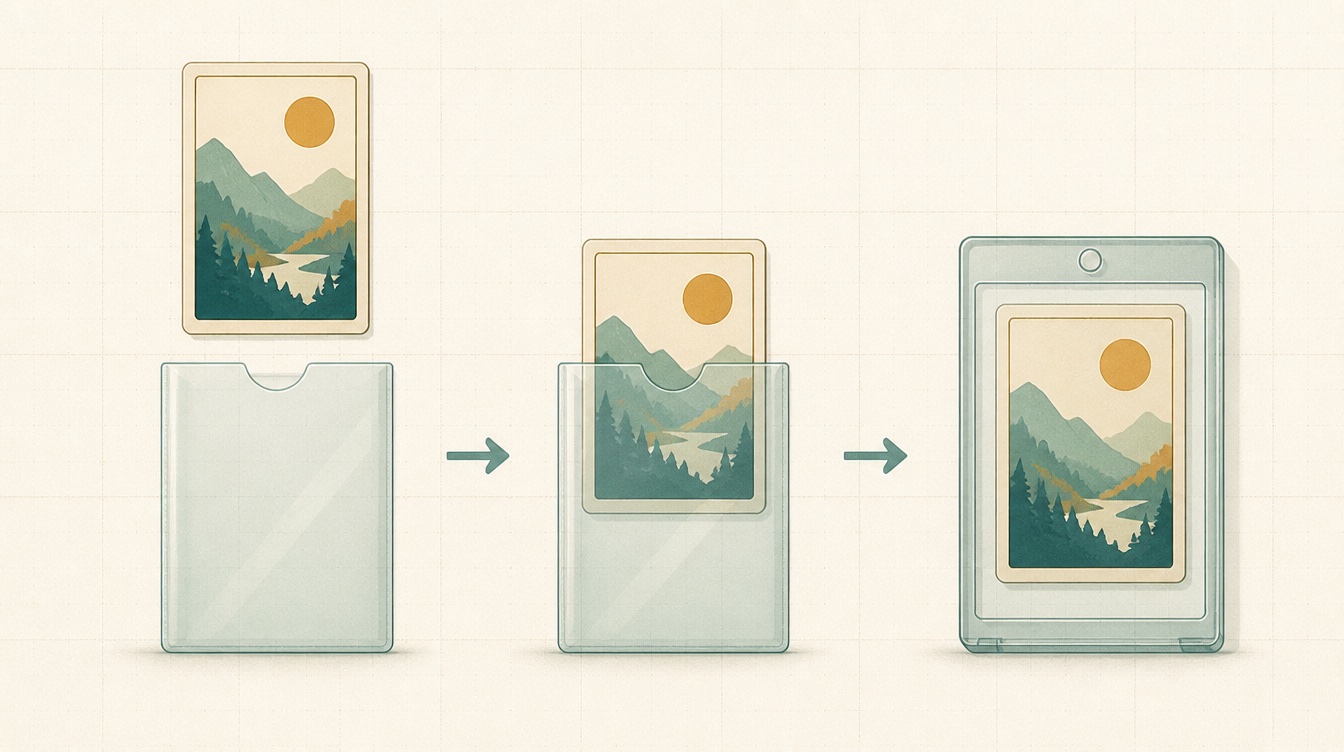 How to prep cards for gradingSleeve the card, slide it into a semi-rigid holder, order the stack to match your submission form, then band it flat. Here's the accepted flow, step by step.Read
 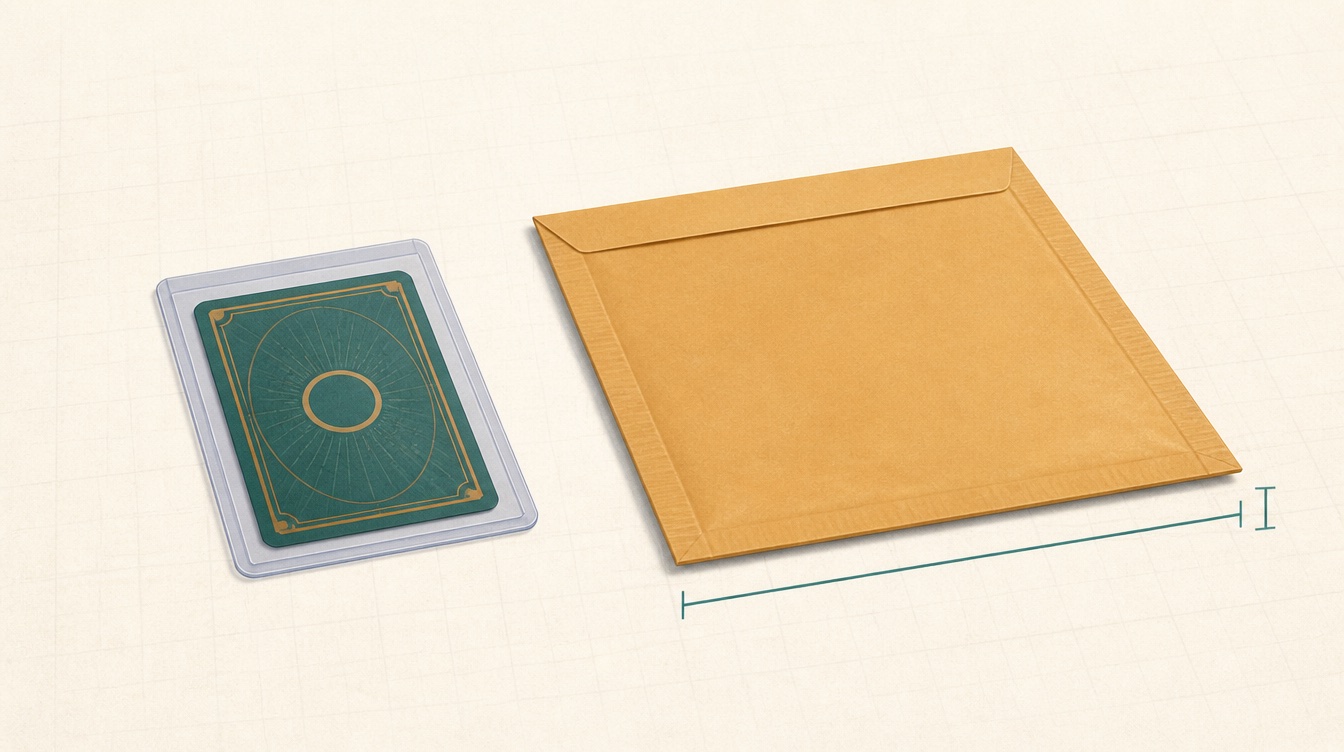 eBay standard envelope: limits and what fitseBay's standard envelope covers small, low-value items like single trading cards, and its weight, thickness, and value caps decide whether a toploader fits.Read
  Card stuck in a toploader? Do thisDon't force it. Try gravity and a corner-first nudge first, then cut the toploader open if the card matters more than the holder. Here's why cards jam.Read
 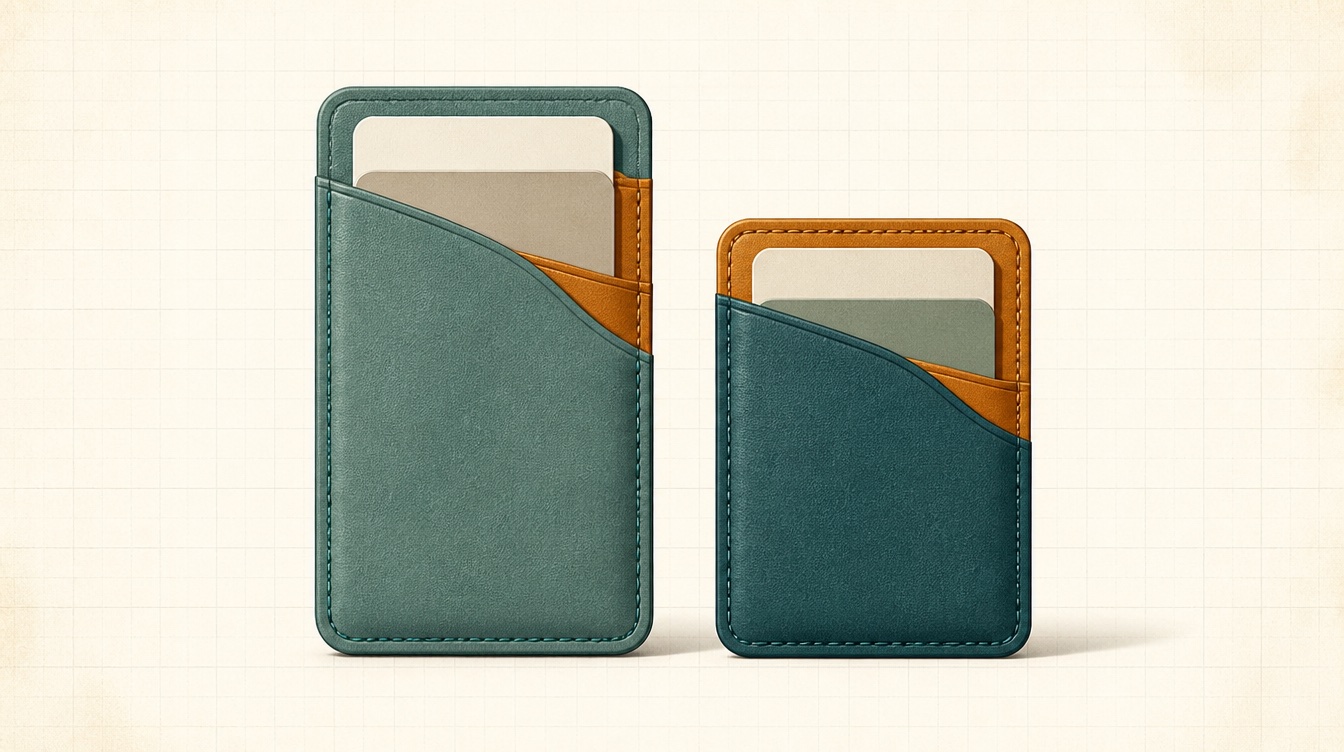 Card Saver 1 vs Card Saver 2Card Saver 1 runs about 3 5/16 x 4 7/8 inches and Card Saver 2 about 3 x 4 inches. Here's what that size gap means for fit, and which one PSA names by name.Read
 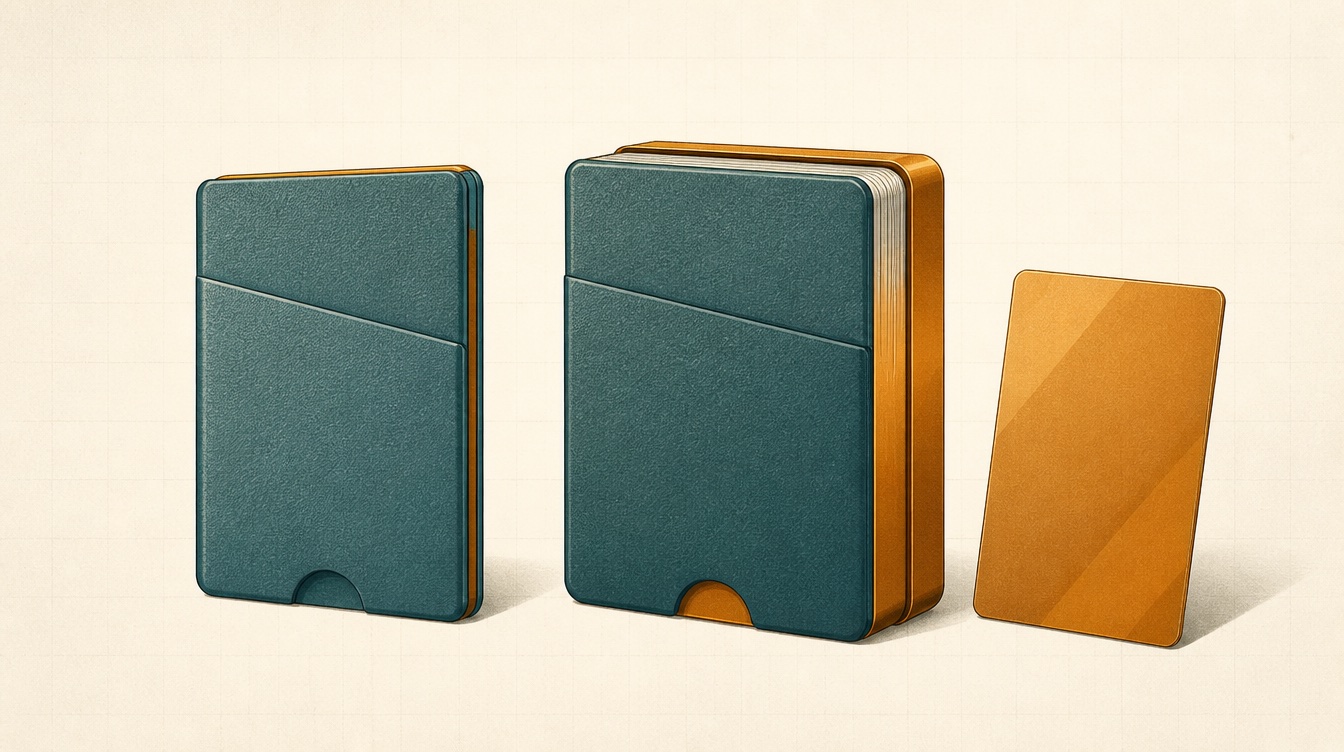 35pt vs 55pt toploaders: when to size upA 35pt toploader holds about 0.89mm of card, a 55pt holds about 1.40mm. That extra 0.51mm is the difference between a raw card and a thick modern pull.Read
 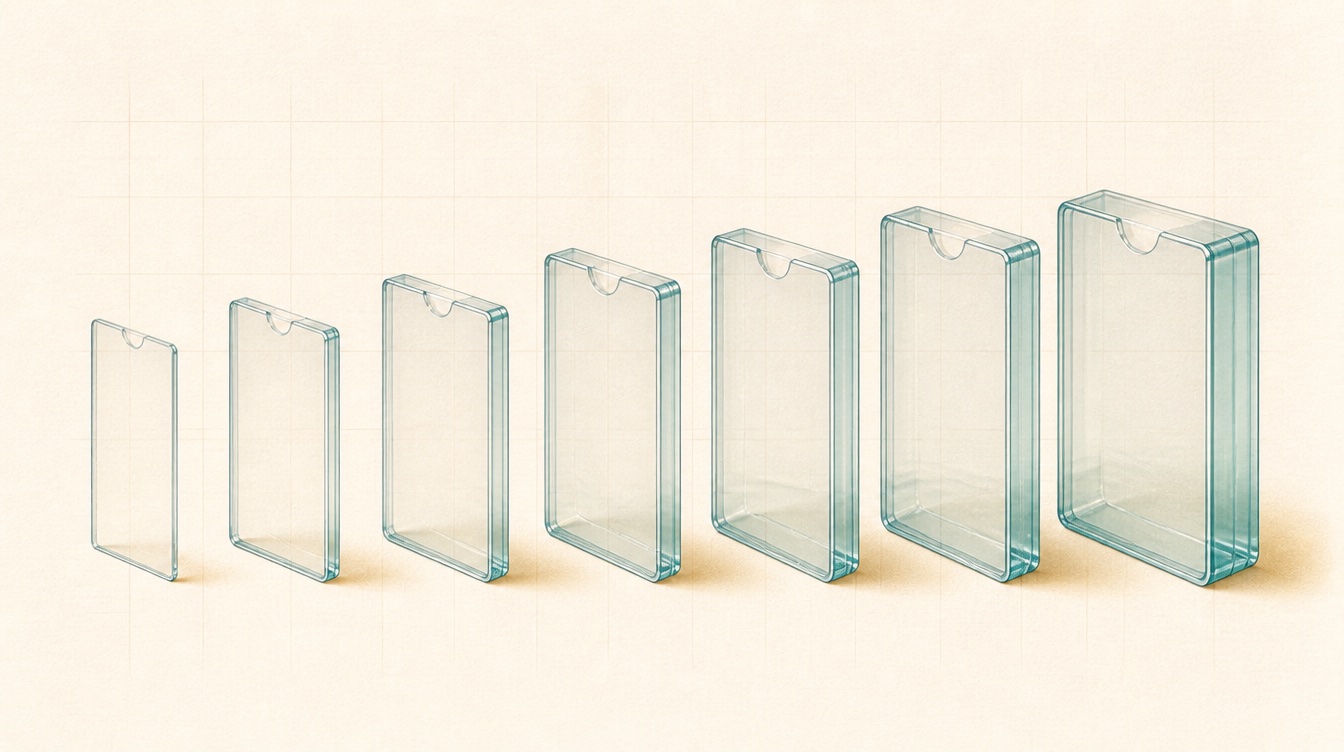 Toploader size chart: 35pt to 360ptEvery toploader pt rating from 35 to 180 converted to mm, plus what each size actually holds, from a raw card to thick jersey and patch inserts, in one table.Read
 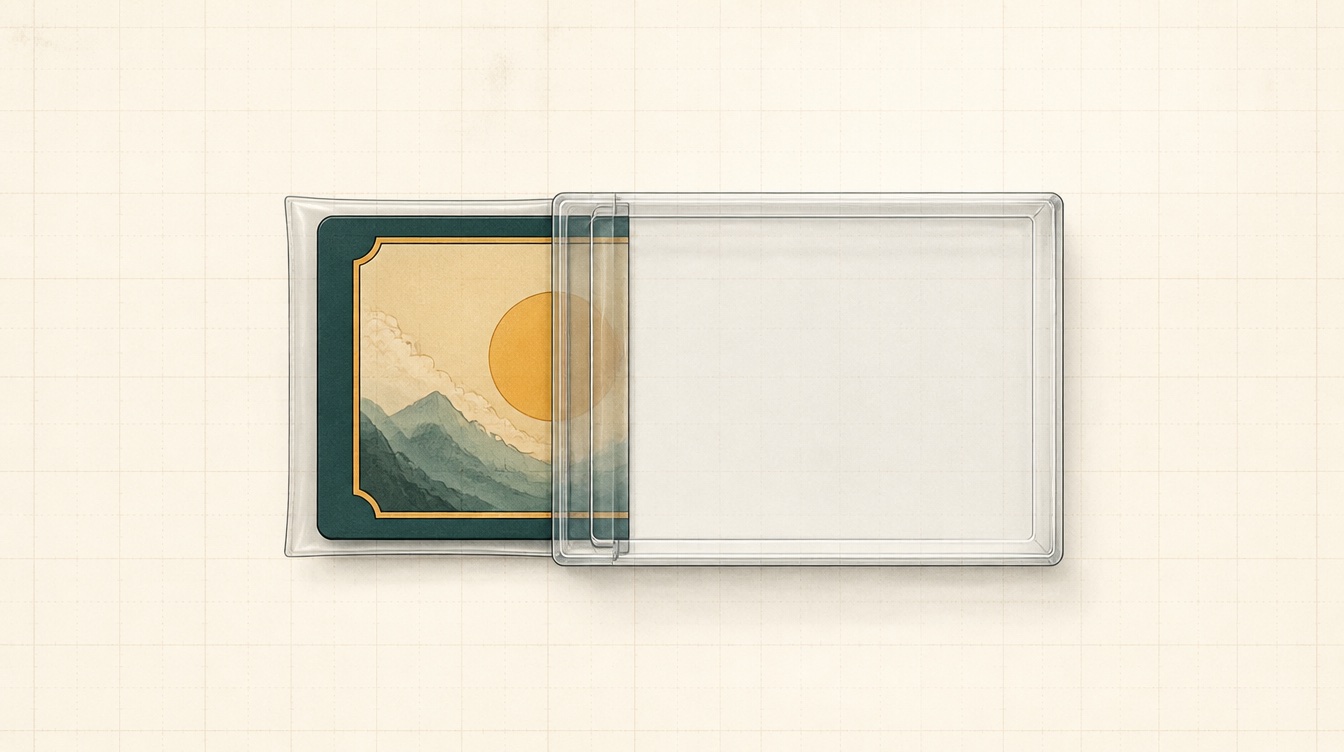 Do sleeved cards fit in toploaders?Penny sleeve plus toploader is the standard combo and it fits with room to spare. Here's the width math, and which sleeves actually run too wide.Read
  Yu-Gi-Oh tournament sleeve rulesKonami requires Main and Side Deck sleeves to match exactly, allows a different set for the Extra Deck, and bans reflective or oversized sleeves.Read
  Do sleeved cards fit in an ETB box?Single sleeves fit an Elite Trainer Box by design, since it ships with 65 of them. Double sleeving is the honest question, and here's why the math says no.Read
  Storing jumbo Pokemon cardsJumbo Pokemon promos don't fit standard 63x88mm gear, and purpose-made oversized storage is still thin. Here's what actually protects one long term.Read
  Yu-Gi-Oh card size: why your sleeves don't fitYu-Gi-Oh cards measure 59x86mm, smaller than Magic or Pokemon. That's why standard sleeves fit loose. Here's the real size and what to buy instead.Read
 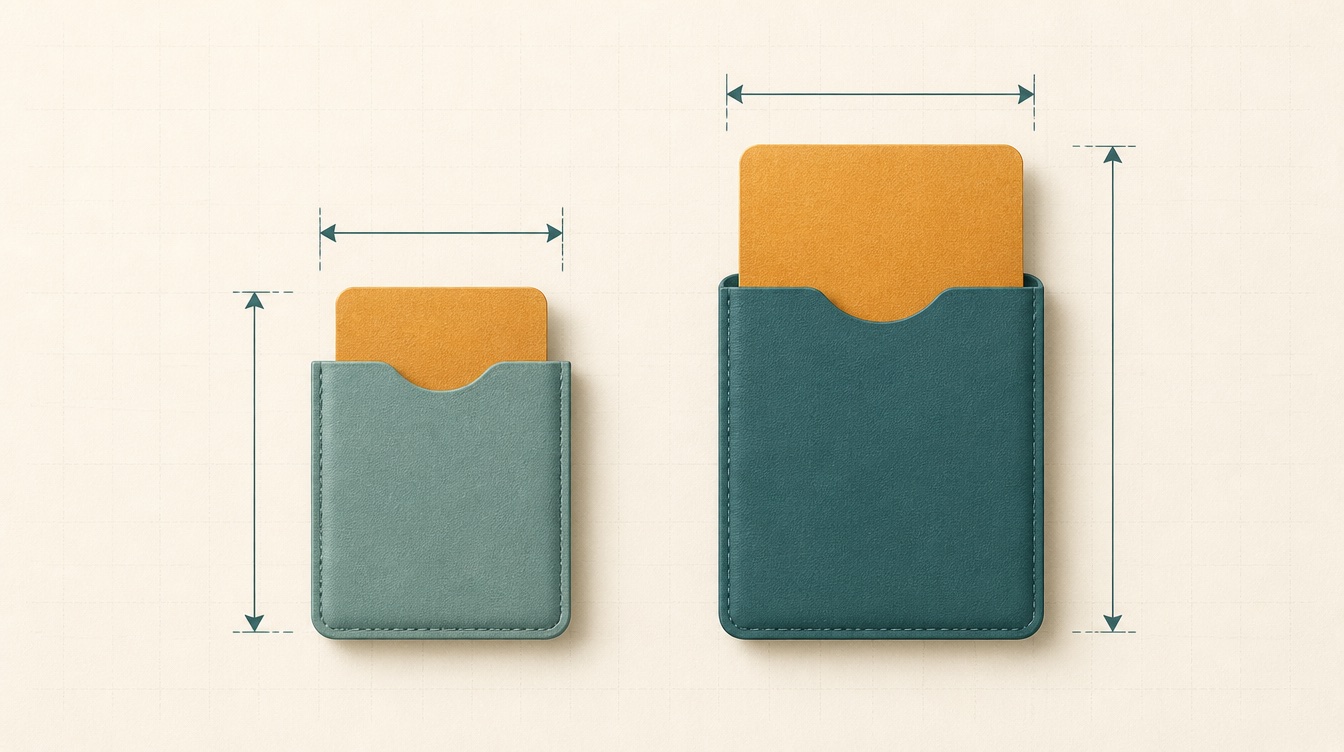 What sleeves fit Yu-Gi-Oh cardsYu-Gi-Oh cards need Japanese-size sleeves, around 62x89mm, not standard sleeves. Here's every brand that makes them and the inner sleeves for double sleeving.Read
 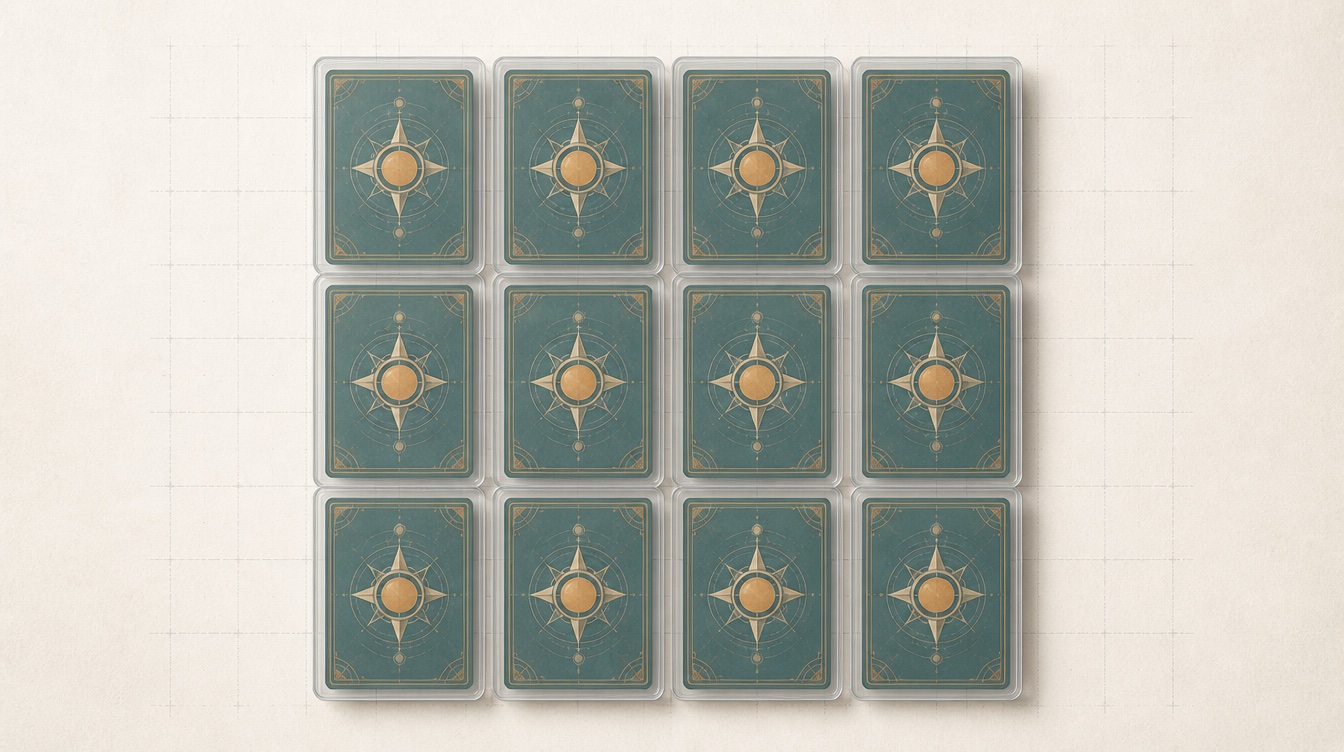 Tournament legal sleeves for PokemonPlay! Pokemon requires sleeves to be identical, non-reflective, and either plain or officially licensed. Here's what passes deck check and what gets flagged.Read
  Tournament legal sleeves for MagicDouble sleeving is allowed at most Magic tournaments if every card in the deck gets identical, unmarked sleeves. Here's the settled shape of the rule.Read
 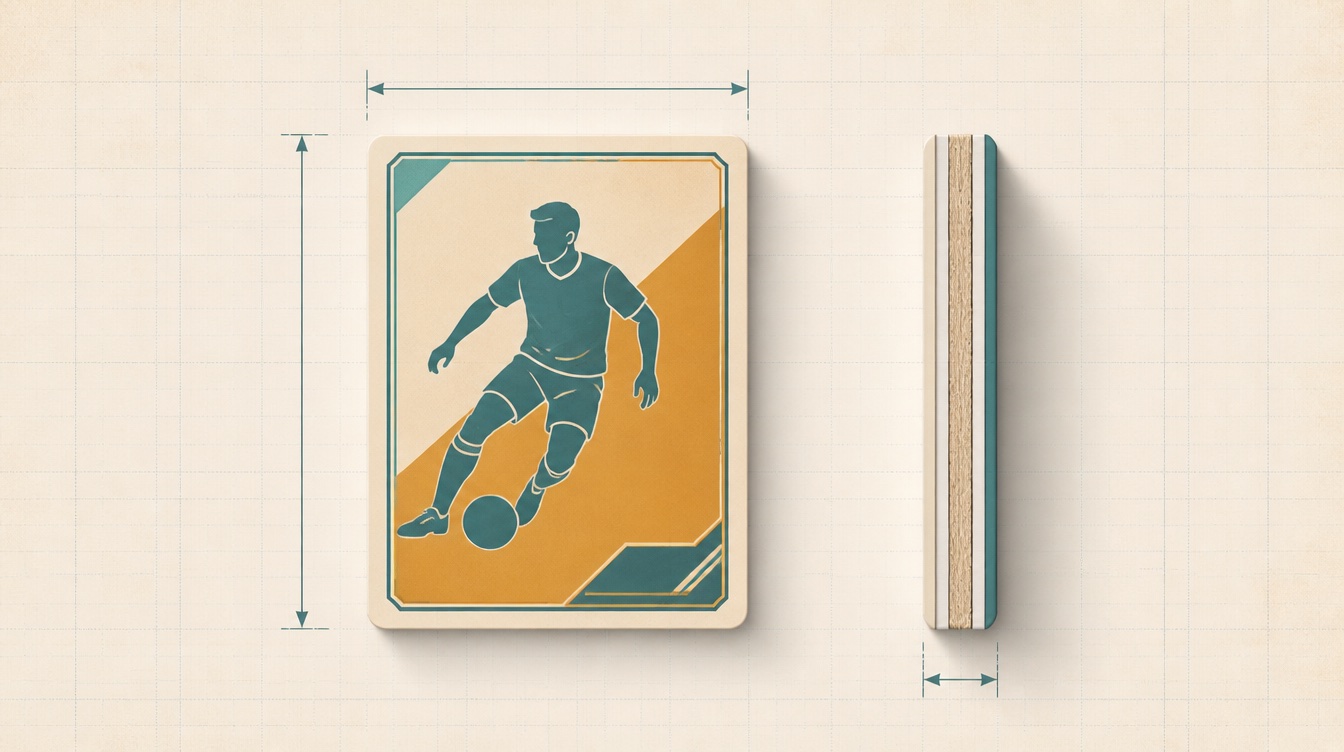 Sports card dimensions (and why thickness varies)Sports cards measure 63.5x88.9mm, exactly 2.5x3.5in. The footprint is fixed, but thickness varies a lot by product, which is why toploaders come in pt sizes.Read
 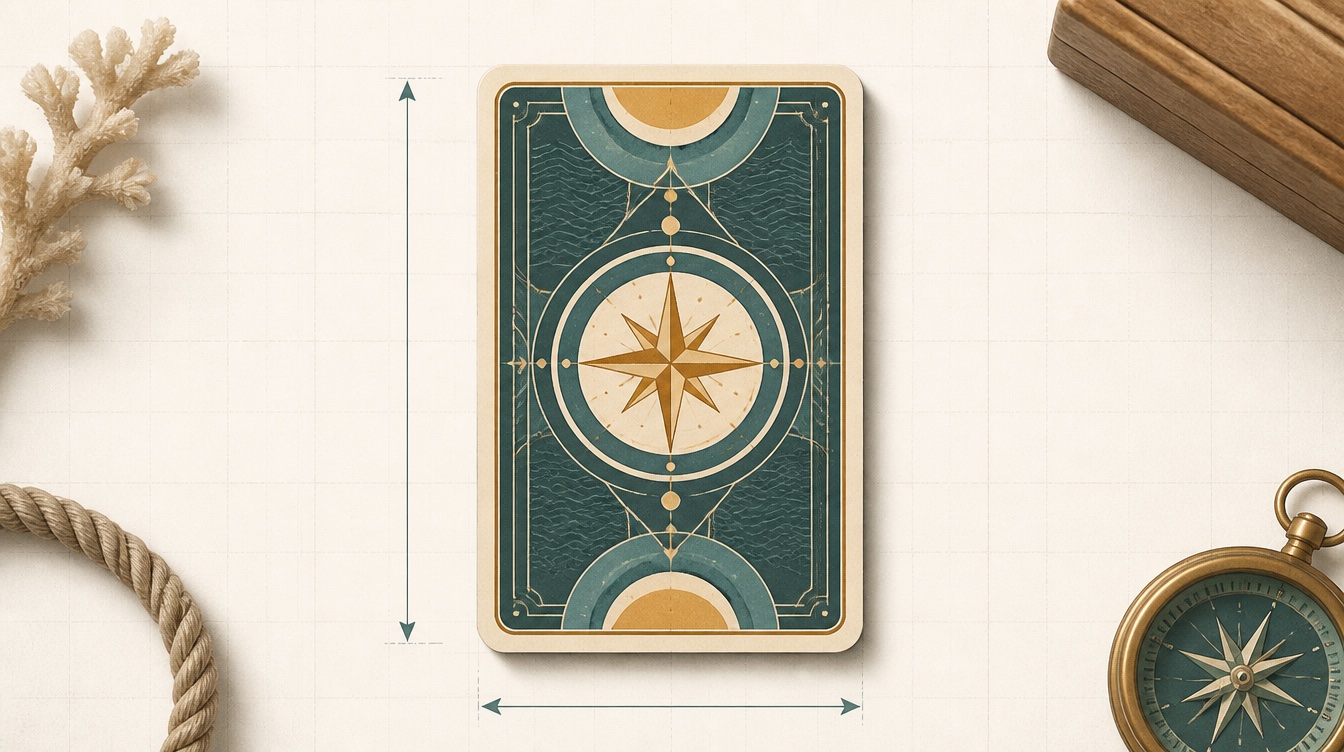 One Piece card size and what gear fitsOne Piece Card Game cards measure 63x88mm, identical to Pokemon and Magic. Here's the exact size in inches and which sleeves, toploaders, and binders fit.Read
  Magic card size: dimensions that matterA Magic: The Gathering card measures 63x88mm (about 2.48 x 3.46 in), 0.305mm thick. Here's what that means for sleeves, inner sleeves, and toploaders.Read
  Lorcana card size: 63x88mm, same as MagicA Disney Lorcana card measures 63x88mm, 0.305mm thick, the same standard size as Magic and Pokemon. Here's what sleeves, toploaders, and binders fit it.Read
  Japanese vs English Pokemon cards: same size?Yes. Japanese-print and English-print Pokemon cards are both 63x88mm standard size. The sleeve confusion comes from a different game's naming, not Pokemon's.Read
  Flesh and Blood card sizeA Flesh and Blood card measures 63x88mm, the same standard size as Magic and Pokemon. Here's what that means for sleeves, toploaders, and binders.Read
  What an Elite Trainer Box actually holdsAn Elite Trainer Box packs boosters, sleeves, dice, and a divider tray in one box. Here's everything inside it, and what the empty box is good for after.Read
  Are all TCG cards the same size?No. Trading card games split into two sizes, standard 63x88mm and Japanese small 59x86mm. Here's which games use which, and a full comparison table.Read
  Pokemon card size (and everything that fits it)Pokemon cards measure 63x88mm (about 2.48 x 3.46 in), the same footprint as Magic and One Piece. Here's what that means for sleeves, toploaders, and binders.Read
  Sorting 1,000+ cards without losing a weekendSort bulk in broad passes, not by perfecting every card. Here's the pass order that gets 1,000+ cards findable in a couple hours instead of a weekend.Read
  UV damage: how sunlight ruins cardsSunlight fades trading cards by breaking down the ink and foil on the surface. Window glass slows this down but doesn't stop it. Here's the actual mechanism.Read
  Should you grade that card?Grade a card when its raw value clears grading costs by a wide margin and its condition holds up to close inspection. Otherwise the fee isn't worth it.Read
  Can you fix a bent corner?Mostly no. A fresh soft bend can improve slightly under flat pressure, but a real crease is permanent, and disguising one is a different problem than fixing it.Read
  Polypropylene vs PVC for card storageWhy polypropylene became the standard sleeve and page material, what PVC did wrong, and how the two plastics actually behave over years of storage.Read
  Can cards warp inside sleeves?Yes, cards can warp inside sleeves, but the sleeve is rarely the cause. Humidity swings, foil stock, and pressure from overstuffed storage do the real damage.Read
  When to sleeve a card (a value threshold that works)Sleeve any card worth more than a couple dollars, and sleeve anything you play regardless of value. Bulk commons under that line can stay loose in a box.Read
  How to clean a trading card (carefully)The honest answer is barely at all. A dry microfiber wipe handles dust and fingerprints; anything wet or abrasive risks the card's coating and its grade.Read
  Do sleeves increase card value?No, a sleeve doesn't add value to a card. It preserves the condition the card already has, which protects the value that condition supports.Read
  Do sleeves ever damage cards?Sleeves rarely damage cards on their own. The real risks are trapped moisture, old PVC plastic, and dirty sleeves, not the act of sleeving itself.Read
  What double sleeving a deck actually costsRough retail math for double sleeving a 100-card Commander deck, inner sleeves plus outer sleeves, landing somewhere around $15 to $30 depending on brand.Read
  Bulk box or binder? The decisionA card belongs in a bulk box or a binder page based on three things: what it's worth, how often you look at it, and how much space you have to give it.Read
  Are card sleeves worth it?Sleeves cost about a dime and prevent the edge wear and scuffing that actually lowers a card's grade, which makes them worth it for anything above bulk.Read
  Acid free vs PVC free: not the same thingPVC free is about plastic, acid free is about paper. Different materials, different failure modes, and neither guarantees the other on its own.Read
  The right humidity and temperature for card storageThe collector-consensus numbers for storing trading cards: 45 to 55 percent humidity, a stable 65 to 72F, no garages or attics, and how silica gel fits in.Read
 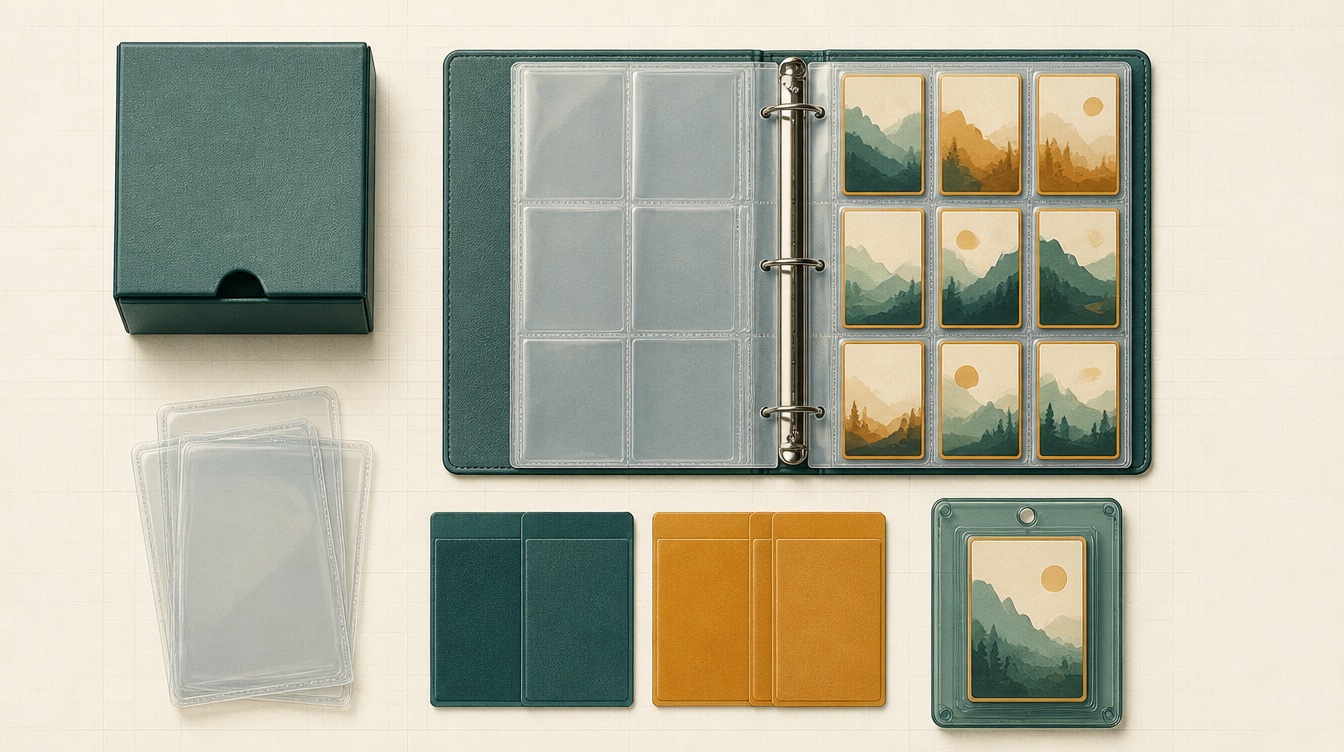 How to store trading cards (the whole system)A tier system for storing trading cards, from bulk boxes to sleeves, double sleeves, toploaders, and one-touches, matched to what each card is worth.Read
Card gear, actually explained
120 guides answering the fit, sizing, and storage questions collectors search for. Every measurement comes from the same database that powers the fit checker.
Sleeves
Which card sleeve brand is actually the thinnestReal film thickness data across 52 sleeves in our directory. Vault X Soft Card Sleeves measure thinnest at 40 microns; Dragon Shield Matte runs thickest at 120.Read  Sticky, grimy sleeves: clean or replace?Sticky sleeves are usually one of two things, surface grime you can wipe off or plastic breaking down underneath. Here's how to tell which is which.Read
  The best sleeves for One Piece cardsOne Piece cards use the 63x88mm standard size, but double sleeving can feel tight. Here's what's true about that complaint and which sleeves to buy instead.Read
  Why your sleeves keep splittingSleeve seams split from repeated shuffle friction, wrong-size sleeves, or a loose penny sleeve doing an inner sleeve's job. Here's what's actually happening and the fix for each.Read
 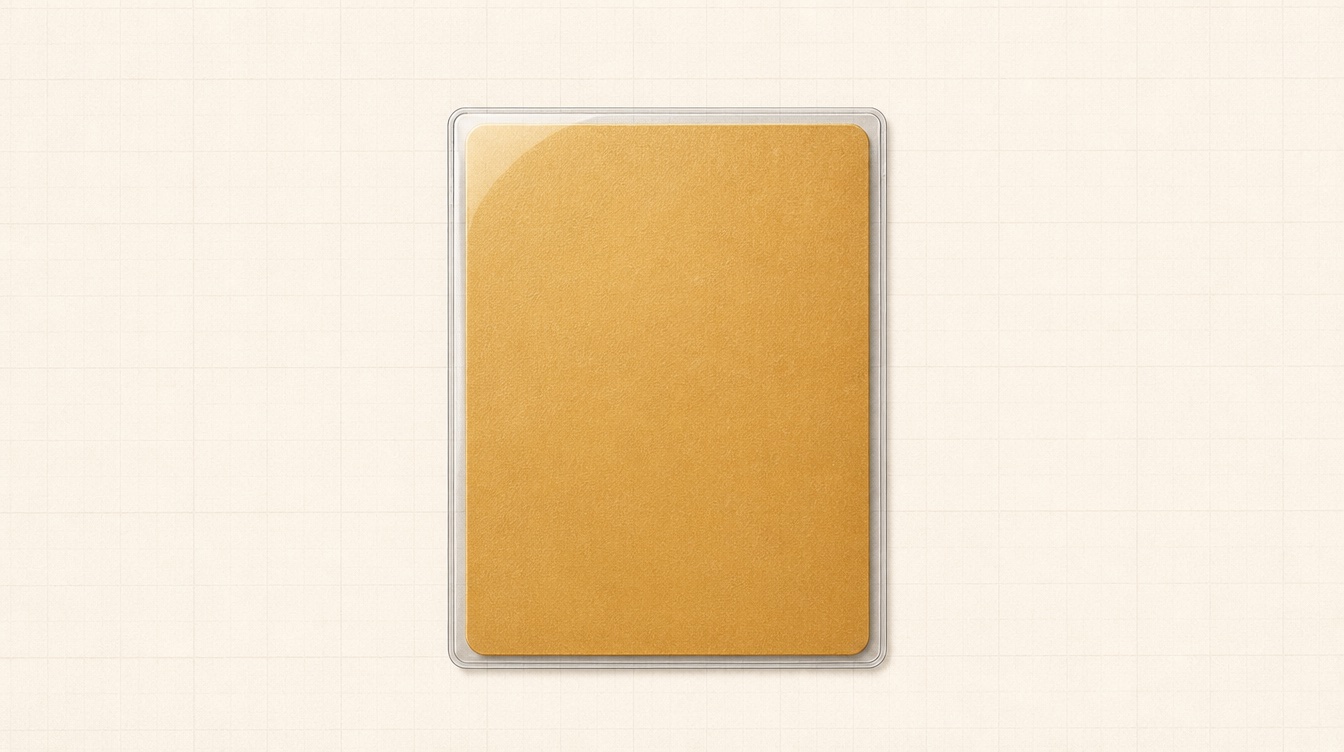 What are penny sleeves (and when are they enough)?Penny sleeves are cheap, single-layer sleeves built for loose storage, not shuffling. Here's what they're actually for and when you need something snugger.Read
 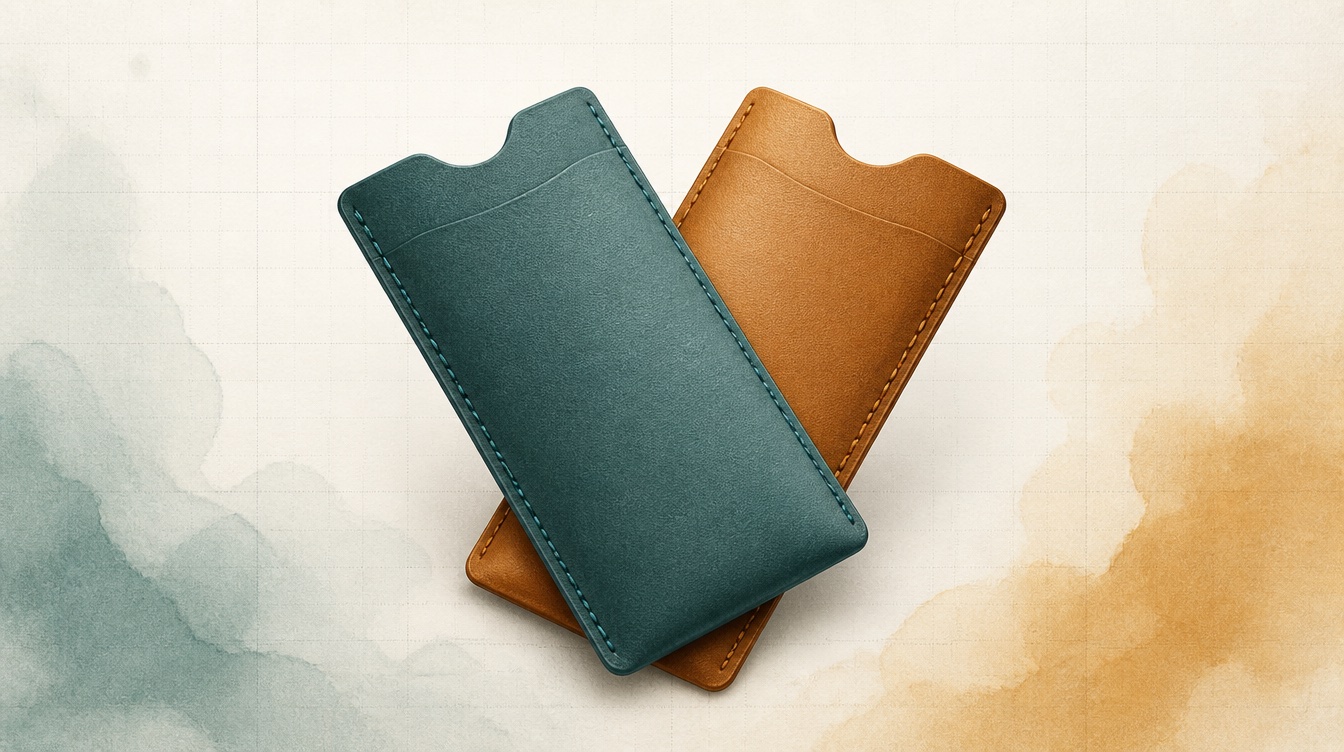 Ultimate Guard Katana vs Dragon Shield MatteKatana and Dragon Shield Matte share the same 66x91mm footprint. The real choice between them comes down to feel and inner sleeve options, not fit.Read
  Sleeves too tight or too loose? How to tellA card that rattles is in a sleeve too big for it; one that bends going in is too small. Here's the millimeter math that shows ideal clearance.Read
 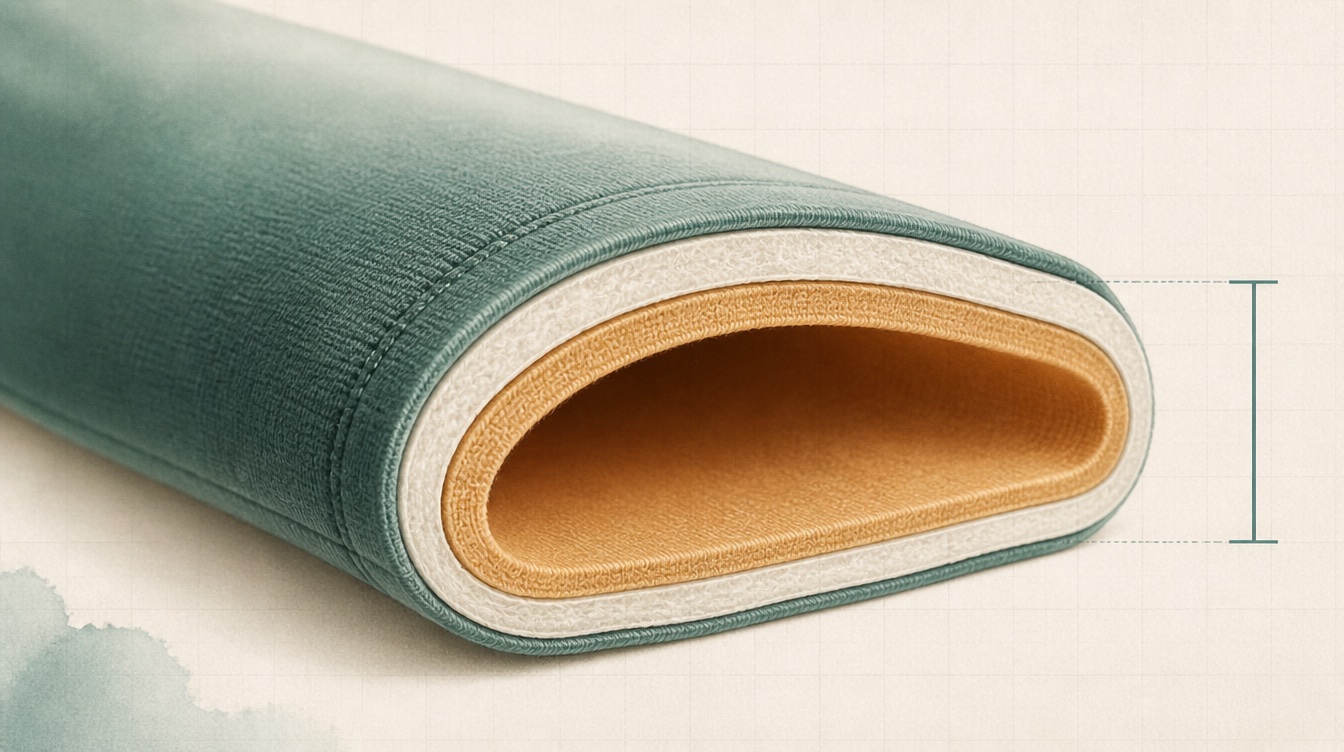 Sleeve thickness in microns, explainedA micron is a thousandth of a millimeter. Here is what that means for a single sleeve and how it adds up across 100 double-sleeved cards in a box.Read
 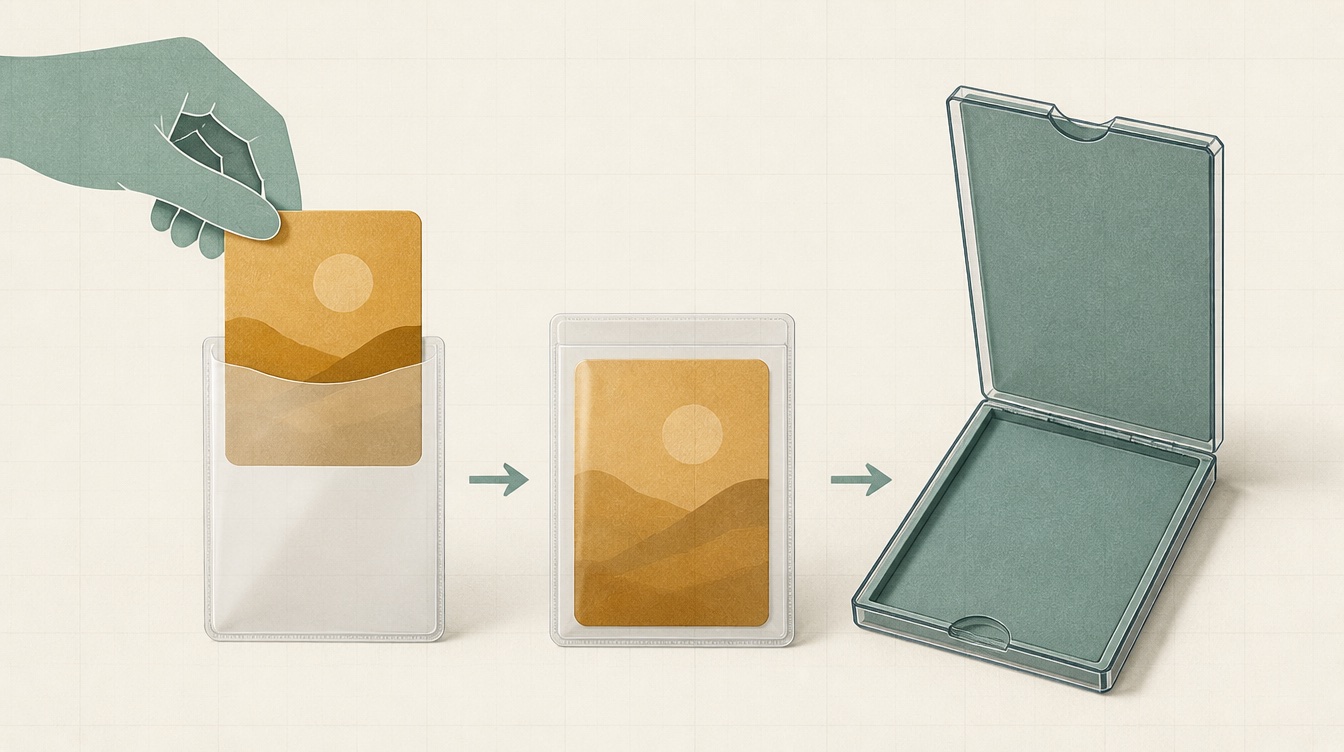 Always sleeve before the toploaderYes, sleeve a card before a toploader. A penny sleeve stops a card sliding against rigid plastic, and the millimeter math shows exactly how much room it uses.Read
 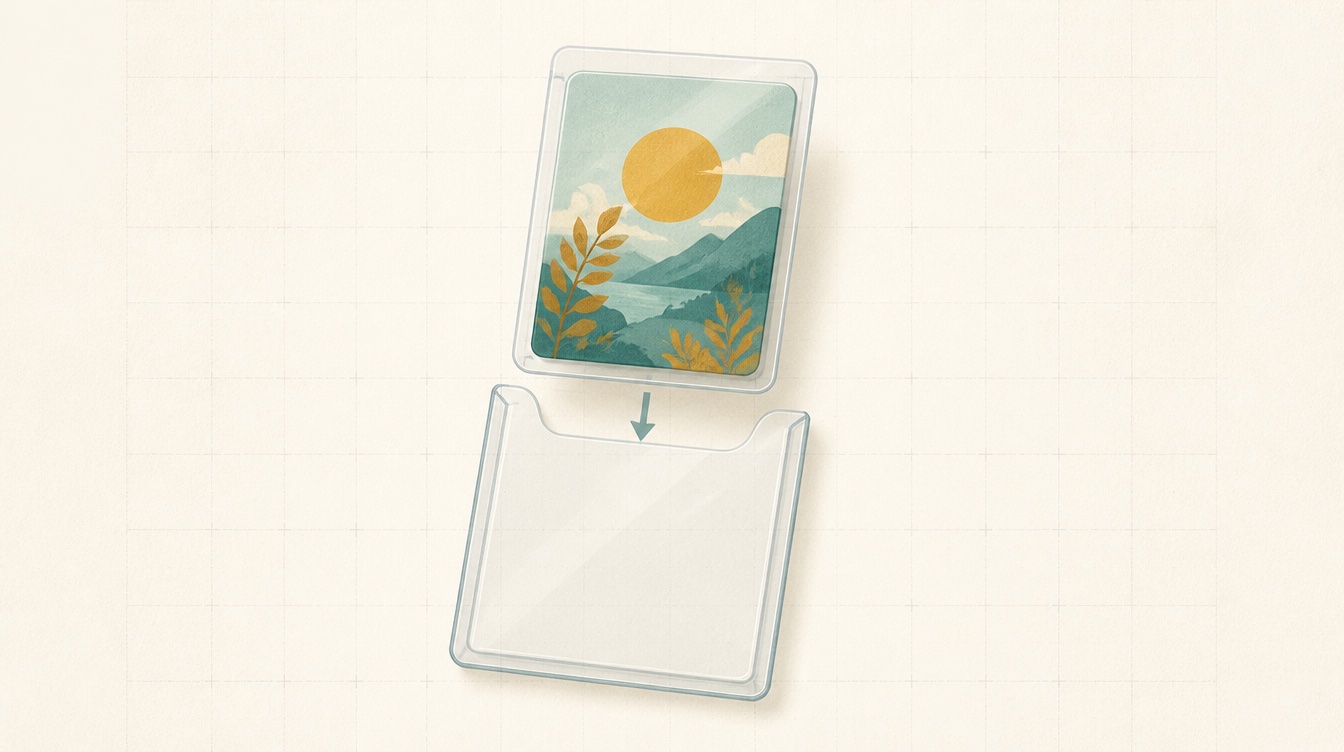 Oversleeves: protecting the sleeve itselfAn oversleeve needs about 3mm of extra room on each side of a standard sleeve, the same clearance a sleeve gives a card. Here's the sizing math.Read
 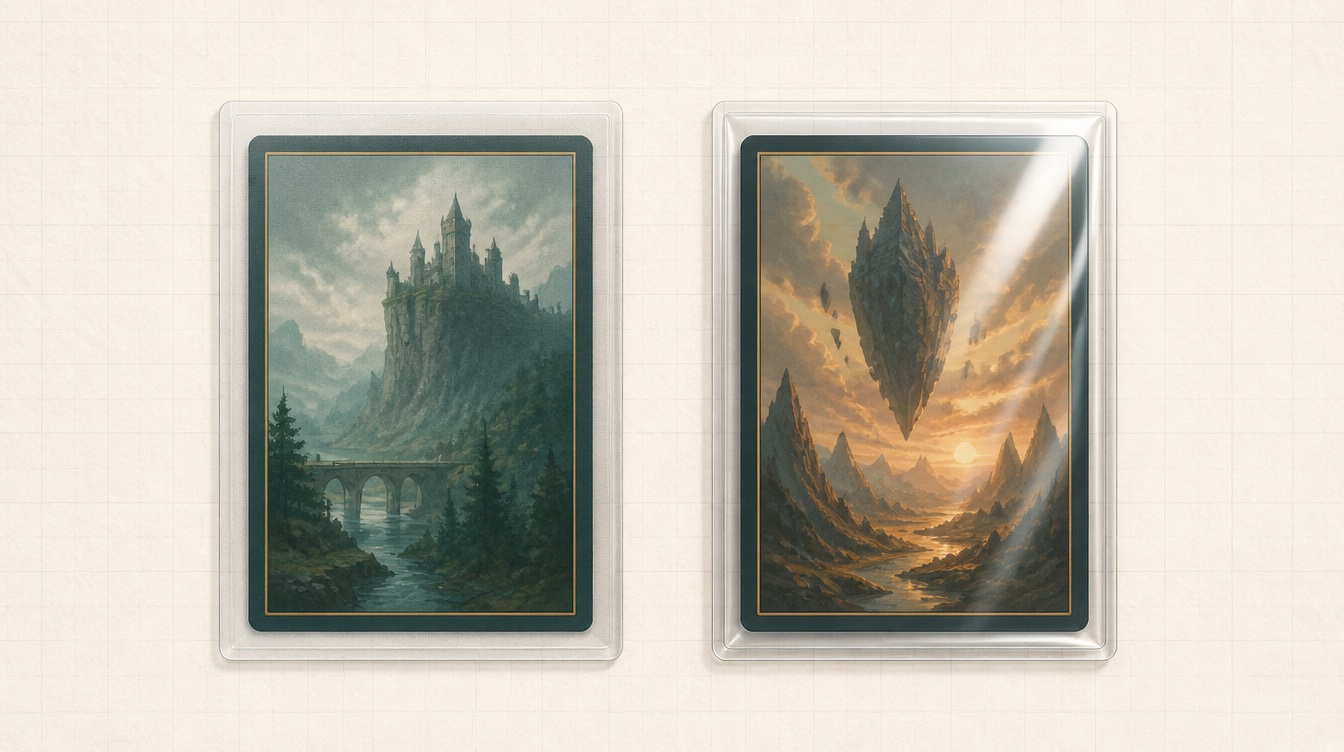 Matte vs glossy sleevesMatte and glossy sleeves are the same size in nearly every brand. The real difference is shuffle feel and how foils look through the plastic.Read
  Is double sleeving worth it?Double sleeving pays off for cards you shuffle often and actually care about protecting. Here's the real thickness and fit tradeoff behind that decision.Read
 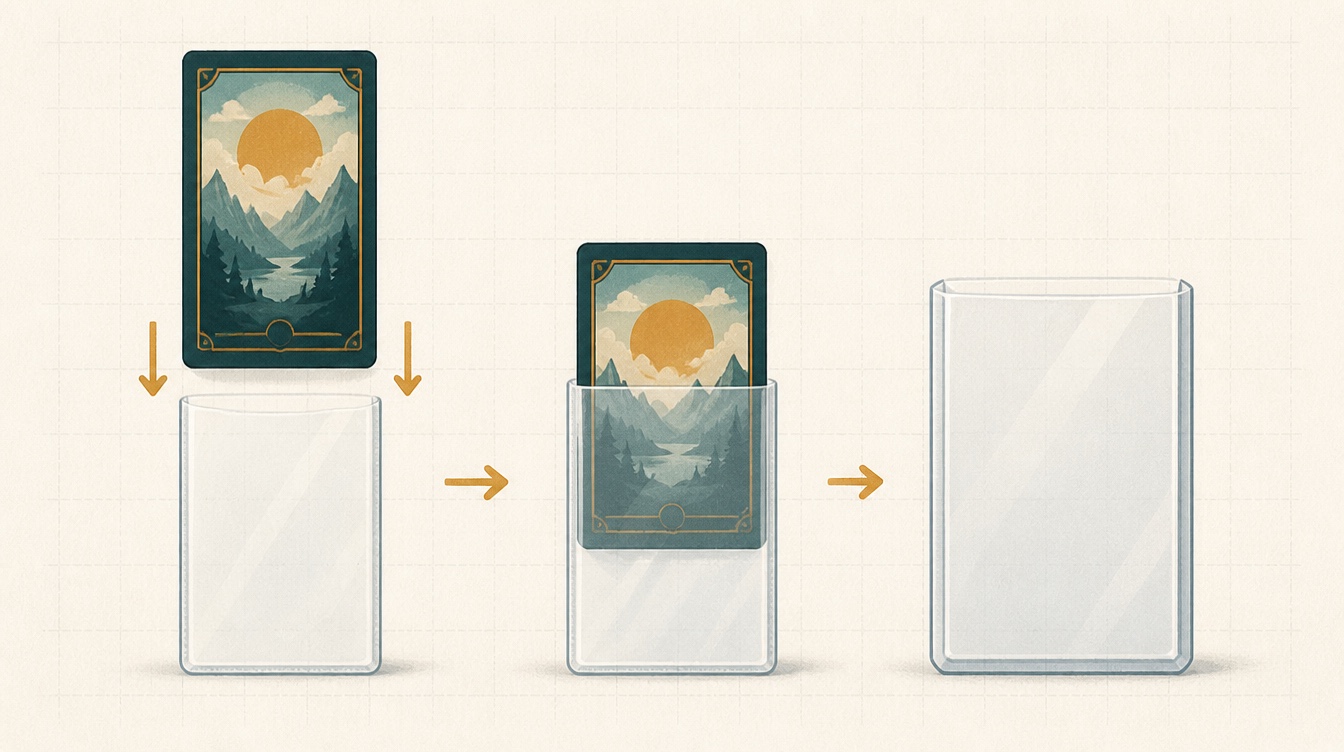 How to double-sleeve cards: orientation, air and box fitPut an inner sleeve on first with its opening at the bottom, then add the outer. A practical guide to orientation, trapped air and checking deck box space.Read
  How many sleeves come in a pack?Pack counts vary by brand and line, but the real question is per-deck math. Here's how many sleeves a 60-card deck or 100-card Commander deck needs.Read
  Dragon Shield vs KMC vs Ultra Pro sleevesDragon Shield and Ultra Pro standard sleeves match at 66x91mm, but KMC runs a millimeter taller. Here's the real size comparison and where it matters.Read
 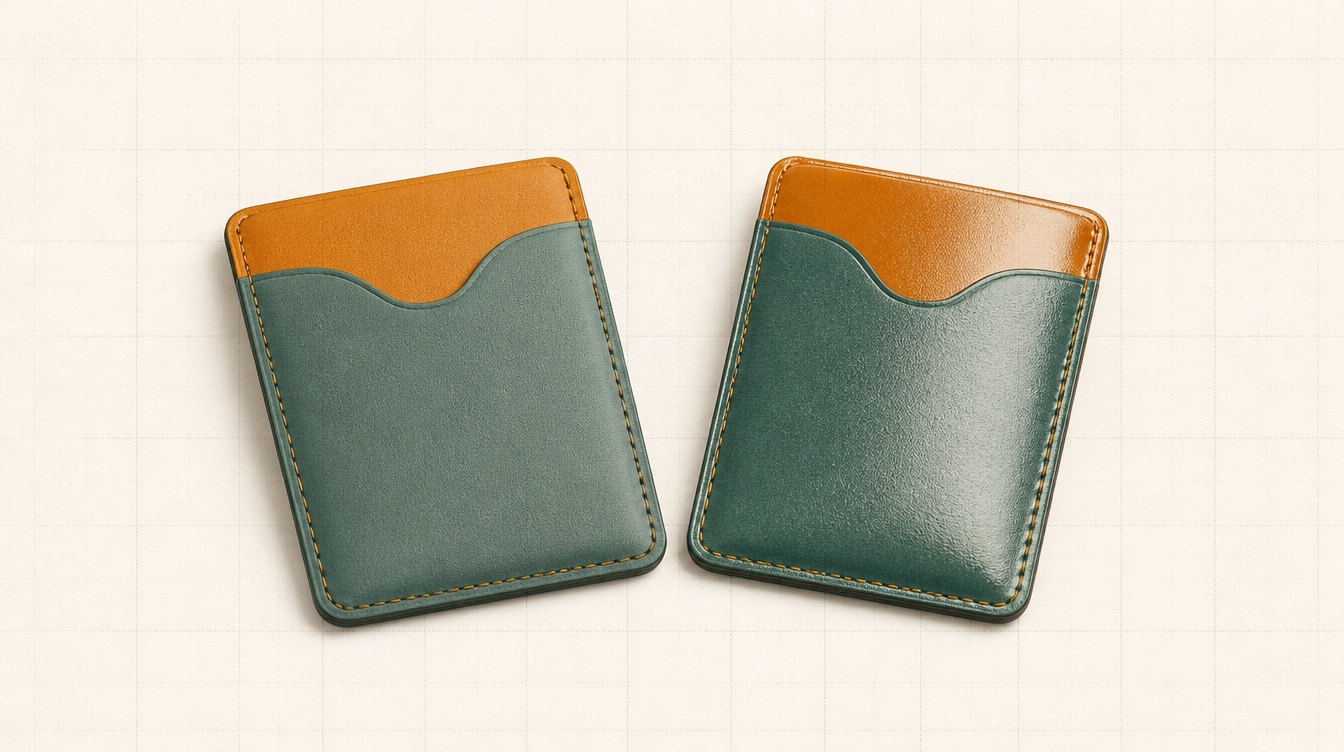 Dragon Shield Matte vs Dual MatteDragon Shield Matte and Dual Matte are the same 66x91mm size, so fit isn't the question. The real difference is which sides get the matte texture.Read
 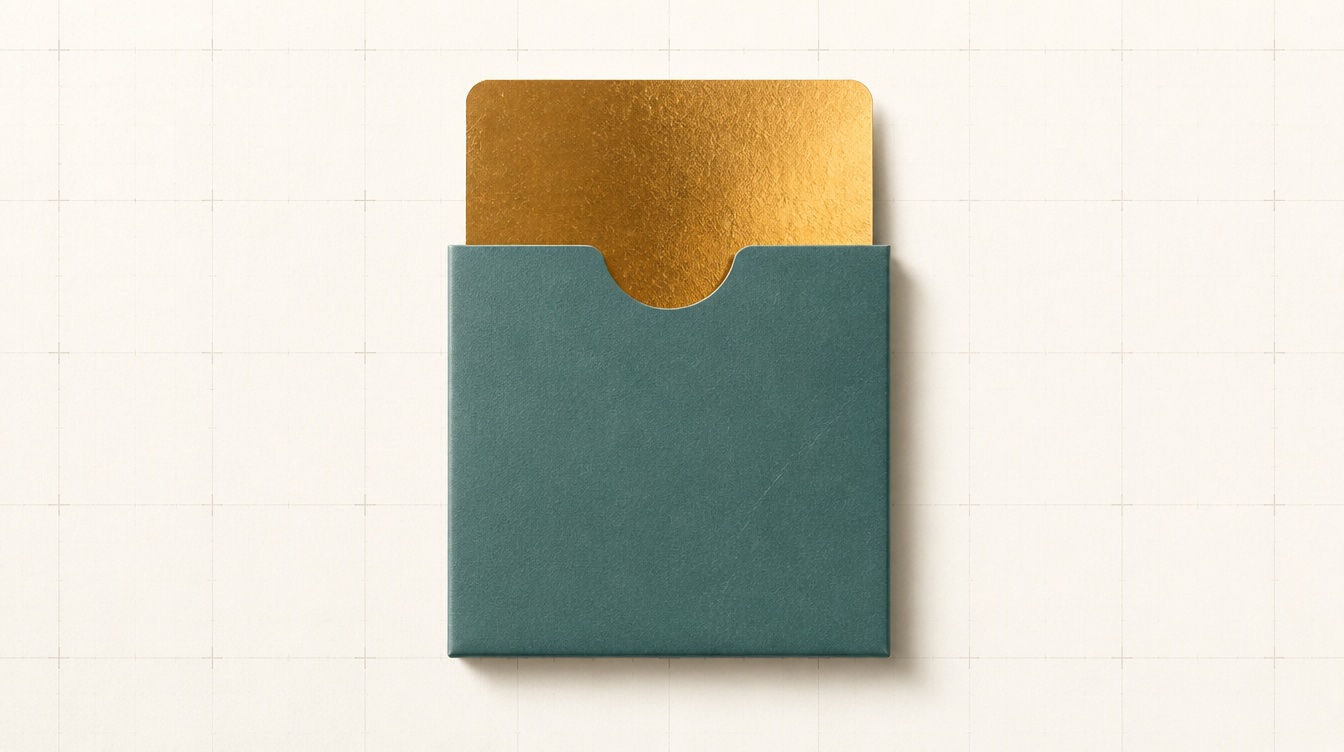 Do matte sleeves scratch foils?Matte sleeves don't scratch foils under normal use. The real risk to a foil's surface is grit trapped inside the sleeve, not the sleeve's finish.Read
  The best sleeves for shufflingThe best sleeves for shuffling are matte, not glossy, and sized close to the card. Here's why finish beats brand name and which sizes stay snug.Read
  The best sleeves for Pokemon cardsPokemon cards need a 63x88mm standard sleeve. Here's which finish to buy first, which inner sleeve to add for a valuable pull, and when to size up.Read
  The best sleeves for LorcanaDisney Lorcana cards use the 63x88mm standard size, so the sleeves that fit Magic and Pokemon fit Lorcana too. Here's what to buy and when to double sleeve.Read
 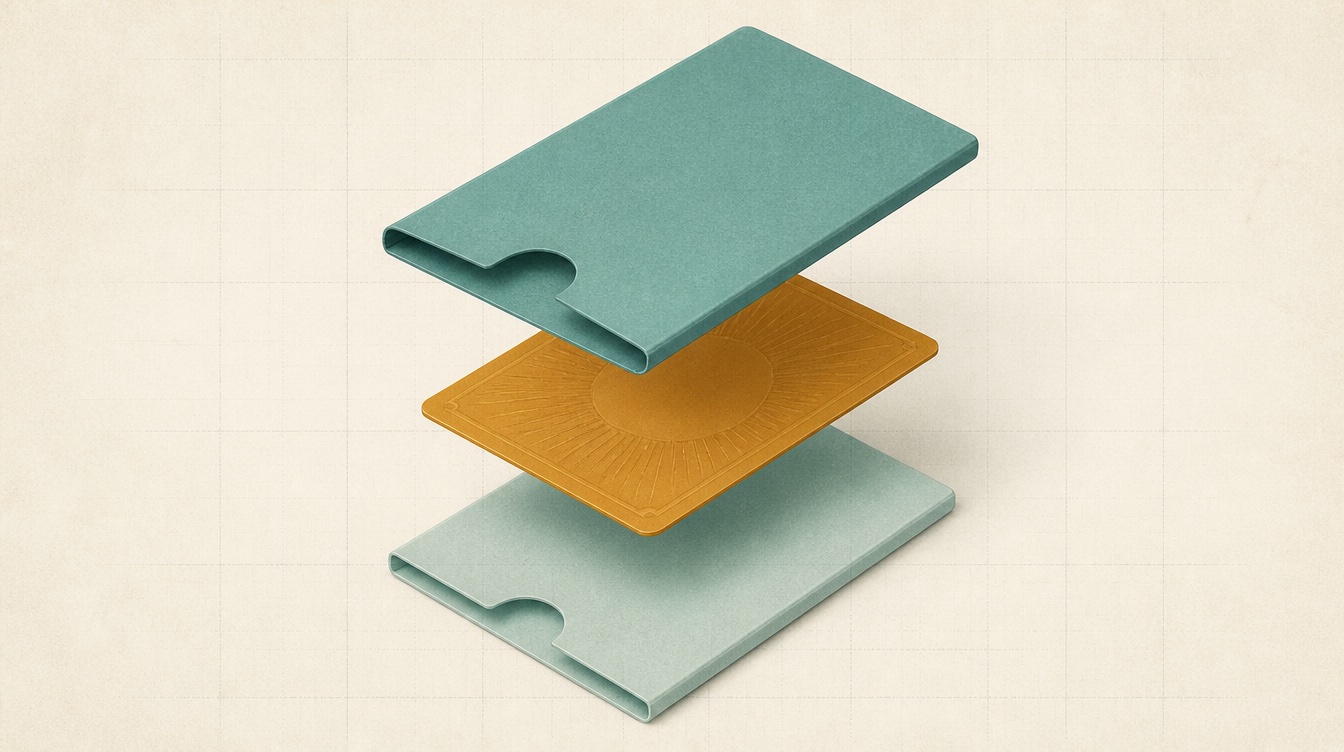 The best sleeve combo for double sleeving CommanderKMC Hyper Mat over KMC Perfect Fit is the safest double-sleeve combo for a 100-card Commander deck. Here is why, and what to do if you want Dragon Shield instead.Read
 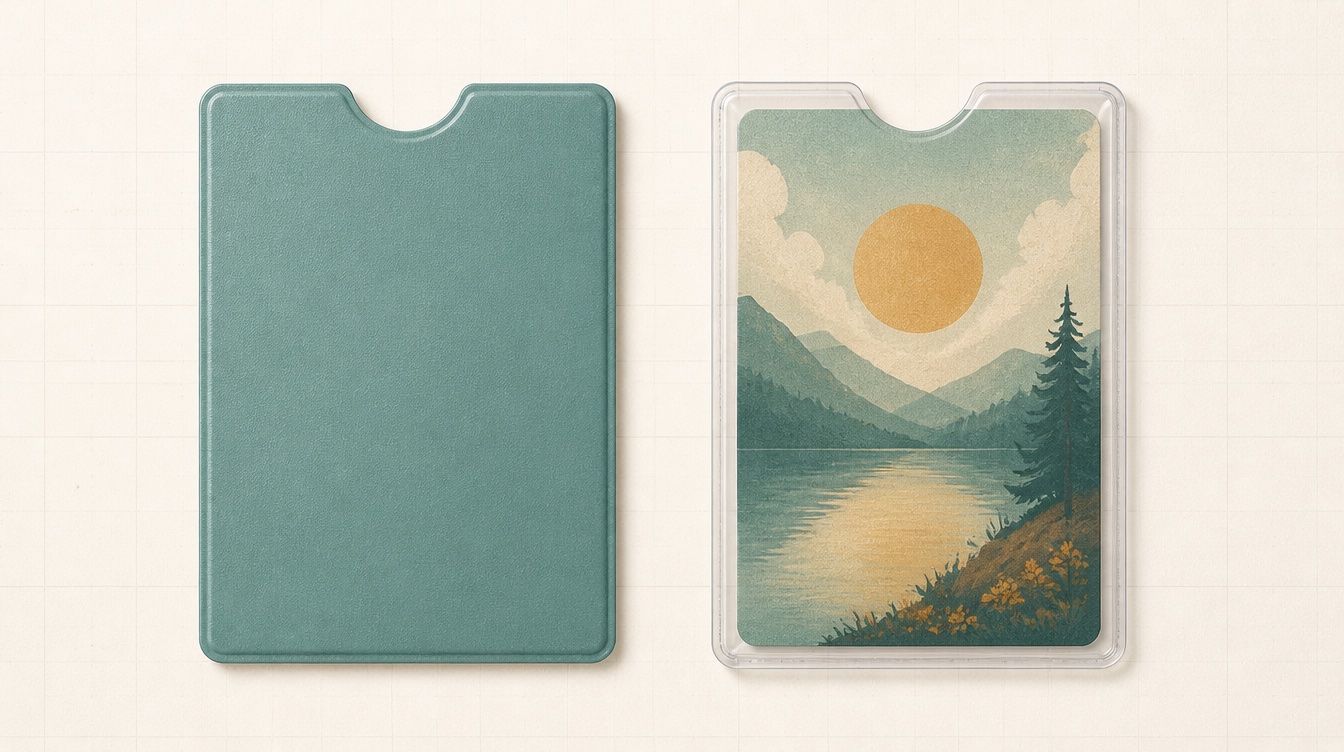 Art sleeves vs clear sleevesArt sleeves and clear sleeves share the same shell size in most lines. The real difference is tournament back-uniformity rules and how art wears over time.Read
  Which way do perfect fit sleeves go in?Perfect fit inner sleeves have a right way in, and it isn't always the obvious way. Here's how orientation works for toploading, sideload, and sealable types.Read
 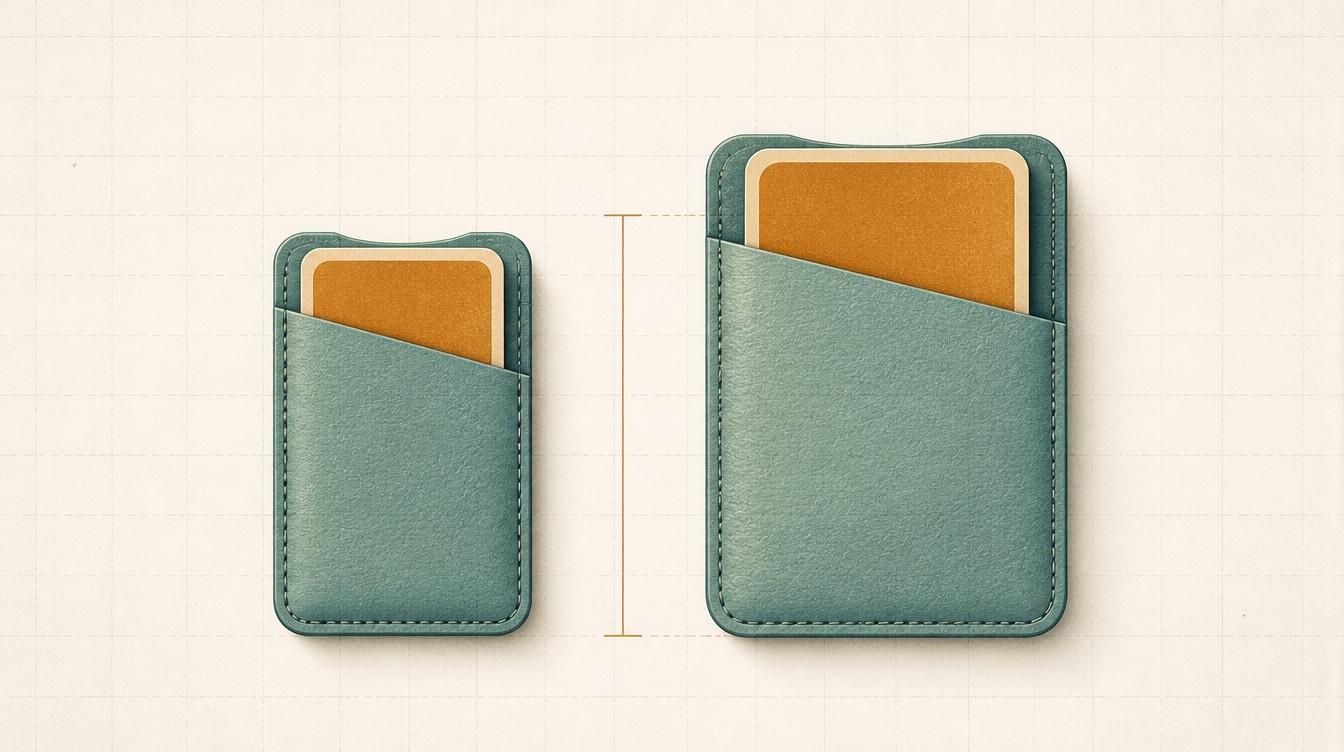 Japanese size sleeves vs standard: which do you need?Japanese-size sleeves run 62x89mm for a 59x86mm card, standard sleeves run 66x91mm for a 63x88mm card. Here's why the difference actually matters.Read
  Standard card sleeve size: the real numbersStandard card sleeves measure 66x91mm, made for the 63x88mm card size Magic, Pokemon, and Lorcana all share. Here is the actual clearance math.Read
 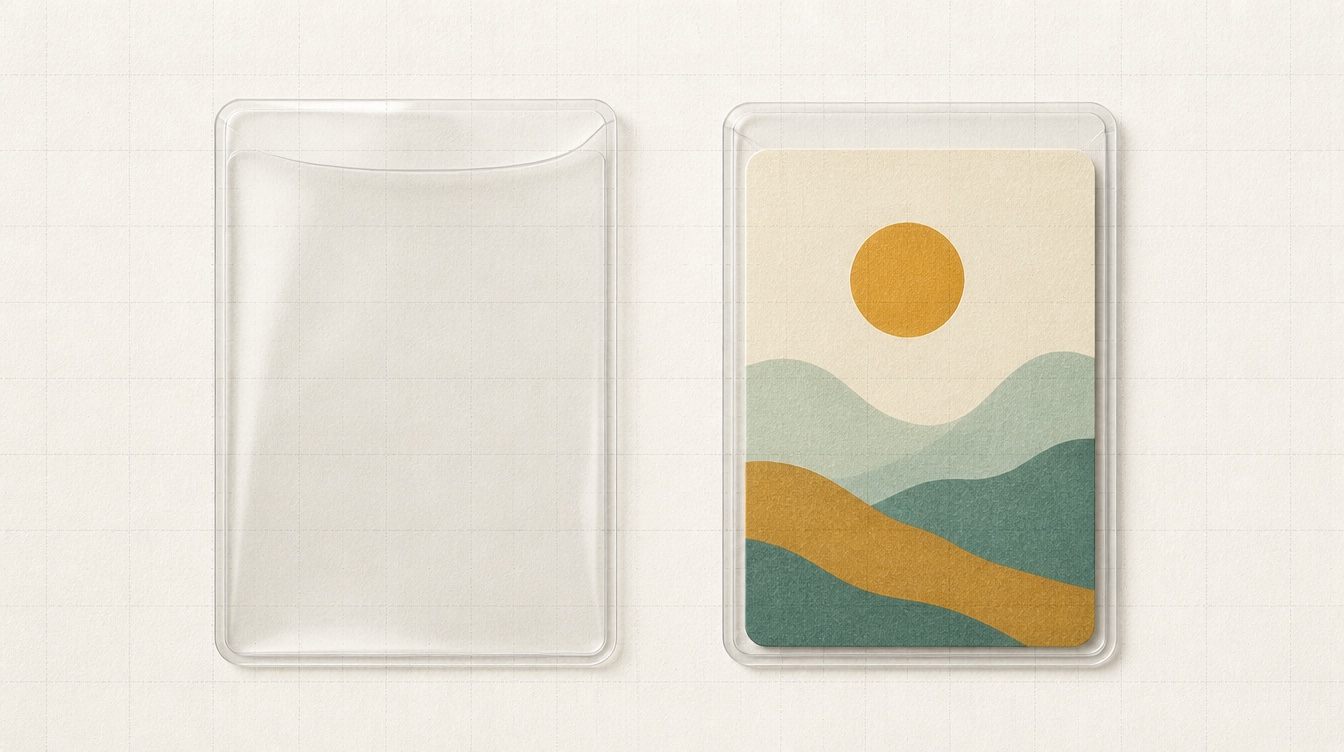 Penny sleeves vs perfect fit sleevesPenny sleeves and perfect fit inner sleeves aren't sized the same job. Here's the size gap that decides which one belongs under your outer sleeve.Read
  What sleeve size does your card game need?Find the sleeve category for Magic, Pokémon, Yu-Gi-Oh!, One Piece, Lorcana and sports cards. Then compare exact product dimensions in the sleeve catalog.Read
Sticky, grimy sleeves: clean or replace?Sticky sleeves are usually one of two things, surface grime you can wipe off or plastic breaking down underneath. Here's how to tell which is which.Read The best sleeves for One Piece cardsOne Piece cards use the 63x88mm standard size, but double sleeving can feel tight. Here's what's true about that complaint and which sleeves to buy instead.Read Why your sleeves keep splittingSleeve seams split from repeated shuffle friction, wrong-size sleeves, or a loose penny sleeve doing an inner sleeve's job. Here's what's actually happening and the fix for each.Read What are penny sleeves (and when are they enough)?Penny sleeves are cheap, single-layer sleeves built for loose storage, not shuffling. Here's what they're actually for and when you need something snugger.Read Ultimate Guard Katana vs Dragon Shield MatteKatana and Dragon Shield Matte share the same 66x91mm footprint. The real choice between them comes down to feel and inner sleeve options, not fit.Read Sleeves too tight or too loose? How to tellA card that rattles is in a sleeve too big for it; one that bends going in is too small. Here's the millimeter math that shows ideal clearance.Read Sleeve thickness in microns, explainedA micron is a thousandth of a millimeter. Here is what that means for a single sleeve and how it adds up across 100 double-sleeved cards in a box.Read Always sleeve before the toploaderYes, sleeve a card before a toploader. A penny sleeve stops a card sliding against rigid plastic, and the millimeter math shows exactly how much room it uses.Read Oversleeves: protecting the sleeve itselfAn oversleeve needs about 3mm of extra room on each side of a standard sleeve, the same clearance a sleeve gives a card. Here's the sizing math.Read Matte vs glossy sleevesMatte and glossy sleeves are the same size in nearly every brand. The real difference is shuffle feel and how foils look through the plastic.Read Is double sleeving worth it?Double sleeving pays off for cards you shuffle often and actually care about protecting. Here's the real thickness and fit tradeoff behind that decision.Read How to double-sleeve cards: orientation, air and box fitPut an inner sleeve on first with its opening at the bottom, then add the outer. A practical guide to orientation, trapped air and checking deck box space.Read How many sleeves come in a pack?Pack counts vary by brand and line, but the real question is per-deck math. Here's how many sleeves a 60-card deck or 100-card Commander deck needs.Read Dragon Shield vs KMC vs Ultra Pro sleevesDragon Shield and Ultra Pro standard sleeves match at 66x91mm, but KMC runs a millimeter taller. Here's the real size comparison and where it matters.Read Dragon Shield Matte vs Dual MatteDragon Shield Matte and Dual Matte are the same 66x91mm size, so fit isn't the question. The real difference is which sides get the matte texture.Read Do matte sleeves scratch foils?Matte sleeves don't scratch foils under normal use. The real risk to a foil's surface is grit trapped inside the sleeve, not the sleeve's finish.Read The best sleeves for shufflingThe best sleeves for shuffling are matte, not glossy, and sized close to the card. Here's why finish beats brand name and which sizes stay snug.Read The best sleeves for Pokemon cardsPokemon cards need a 63x88mm standard sleeve. Here's which finish to buy first, which inner sleeve to add for a valuable pull, and when to size up.Read The best sleeves for LorcanaDisney Lorcana cards use the 63x88mm standard size, so the sleeves that fit Magic and Pokemon fit Lorcana too. Here's what to buy and when to double sleeve.Read The best sleeve combo for double sleeving CommanderKMC Hyper Mat over KMC Perfect Fit is the safest double-sleeve combo for a 100-card Commander deck. Here is why, and what to do if you want Dragon Shield instead.Read Art sleeves vs clear sleevesArt sleeves and clear sleeves share the same shell size in most lines. The real difference is tournament back-uniformity rules and how art wears over time.Read Which way do perfect fit sleeves go in?Perfect fit inner sleeves have a right way in, and it isn't always the obvious way. Here's how orientation works for toploading, sideload, and sealable types.Read Japanese size sleeves vs standard: which do you need?Japanese-size sleeves run 62x89mm for a 59x86mm card, standard sleeves run 66x91mm for a 63x88mm card. Here's why the difference actually matters.Read Standard card sleeve size: the real numbersStandard card sleeves measure 66x91mm, made for the 63x88mm card size Magic, Pokemon, and Lorcana all share. Here is the actual clearance math.Read Penny sleeves vs perfect fit sleevesPenny sleeves and perfect fit inner sleeves aren't sized the same job. Here's the size gap that decides which one belongs under your outer sleeve.Read What sleeve size does your card game need?Find the sleeve category for Magic, Pokémon, Yu-Gi-Oh!, One Piece, Lorcana and sports cards. Then compare exact product dimensions in the sleeve catalog.Read Deck boxes
Traveling with multiple decksCases built to carry more than one deck at once, drawn from our measured data, plus the packing habits that actually protect cards on a real trip.Read Ultra Pro Satin Tower: what it really holdsUltra Pro Satin Tower capacity checked against its real 76mm interior depth, including why it's the community default for double-sleeved Commander decks.Read Boxes that carry two decksThe closest thing to a true two-deck box in our data is Ultimate Guard's Twin Flip'n'Tray line. Here's what it actually holds, and where the numbers run out.Read Sidewinder vs Boulder: side load or top load?Ultimate Guard Sidewinder and Boulder compared by interior depth and real double-sleeve fit, and why side-loading wins for a snug 100-card deck.Read Plastic bins vs cardboard boxes for cardsCardboard is cheaper and fine in a stable room. Plastic bins cost more but hold their shape and shrug off spills. Here's when each one earns its spot.Read Magnetic vs friction deck boxesA magnetic clasp and a friction lid close a deck box differently. Here's how each holds up under a full sleeved stack, with one confirmed magnetic pick.Read Is a premium deck box worth it?Premium deck boxes buy magnetic latches and convertible trays, not automatically more interior room. The measurements say what your money actually gets.Read Storing bulk Magic cards: what actually worksCardboard count boxes still win for true bulk Magic and MTG cards; here's the full storage ladder plus a comparison of every 400 to 2,200-card box.Read How many unsleeved cards fit in a deck box?A standard card is 0.305mm thick, so 100 stack to 30.5mm. Here's the raw thickness math and why real deck boxes fall short of the theoretical max.Read Gamegenic vs Ultimate GuardNo single winner between Gamegenic and Ultimate Guard deck boxes. The measurements say who wins by use case, from basic 100 count to bulk storage.Read Gamegenic Bastion vs Watchtower vs SquireGamegenic's Bastion, Watchtower, and Squire 100+ deck boxes compared on interior depth and the XL fit problem the non-XL versions run into.Read Why your deck box won't close (and what to do)A deck box that won't close with sleeved cards usually comes down to sleeve thickness, air pockets, or a real card count mismatch. Fixes in order of cost.Read Deck box interior depths, one big chartEvery deck box in our data with a documented interior depth, sorted smallest to largest, from a snug 55mm to a cavernous 90mm. Real numbers only.Read Deck boxes for Yu-Gi-Oh: main, extra, sideYu-Gi-Oh needs a box for a 40-60 card main deck plus room for a 15-card extra and side deck. Here's how to size each one using real capacity ratings.Read Deck boxes for a 60-card Pokemon deckA 60-card Pokemon deck only needs a handful of confirmed picks. Here's which boxes are sized for exactly that, and which are worth the extra room.Read Deck boxes that fit a toploaderMost single-deck 100 count boxes are sized for a sleeved card, not a rigid toploader. A few flip-top, tower, and bulk boxes have the room; here's the honest list.Read Commander deck boxes with room for diceThree deck boxes built with genuine room for dice and tokens alongside a 100 card Commander deck, plus what our data can't confirm about tray sizes.Read Cheap deck boxes that still closeA handful of budget deck boxes hold a full sleeved deck without a fight. The priciest textured box isn't always the roomiest one inside.Read Boulder 100+ vs Dragon Shield Nest 100Ultimate Guard Boulder 100+ and Dragon Shield Nest 100 compared on real interior depth and double-sleeve fit, with a verdict for single and double sleeved decks.Read Deck boxes that actually close on a double sleeved deckA double sleeved deck won't fit just anywhere. Here's why closure type and interior depth matter more than the sticker, and where to find verified fits.Read The best deck box for Commander, by the numbersSeven deck boxes that verifiably hold 100 double sleeved cards, ranked by interior depth, with the tightest and roomiest picks called out plainly.Read What an 800-count box really holdsAn 800-count box is rated for raw, unsleeved cards. Here's the actual math on card thickness, and how far that number drops once cards are sleeved.Read Ultimate Guard Boulder sizes, decodedEvery Ultimate Guard Boulder size compared by stated capacity and interior depth, plus why the Boulder 100+ struggles with double-sleeved Dragon Shields.Read What does 100+ actually mean on a deck box?"100+" is a manufacturer capacity claim tested with one sleeve combo, not a promise for yours. Real examples of boxes that pass, fail, or sit tight.Read How many double sleeved cards fit in a deck box?The real math behind "100+": card thickness plus two sleeve layers, stack height versus interior depth, and a worked example using measured combos.Read Binders
Ring binder or zip binder?A zip binder ships as one fixed-capacity book. A ring binder is a cover you load pages into yourself, up to a stated ceiling. Here's the real math.Read Do binders damage cards?A binder doesn't damage cards on its own, but the wrong page material, overstuffing, or storing it flat under weight can. Here's what actually causes it.Read D-ring vs O-ring bindersO-rings are round and let pages bow and drift. D-rings sit flat against the spine, keeping pages stacked evenly and cutting long-term card dent risk.Read Binders for One Piece and LorcanaOne Piece and Disney Lorcana both use the 63x88mm standard card size, so any standard binder in our data holds either one without a fit problem.Read Zip binder vs strap binder: the real trade-offVault X sells the same binder in zip and strap versions at matching capacities, which isolates the closure question. Here's what actually changes.Read Vault X binder sizes: 160 to 1,088 cards comparedCompare Vault X Exo-Tec zip binder capacity, dimensions and pocket size. See what XL and XXL change, and why these pockets do not fit 3×4 toploaders.Read Side loading vs top loading binders, settledSide loading won the binder page format war years ago. Every binder we track, all 39 of them, opens on the side edge instead of the top. Here's why.Read How many cards fit in a binder?The math is pockets per page times two sides times page count. A standard 9 pocket binder holds 360 cards, but toploader pages hold far fewer cards.Read Binders for graded slabsStandard 9-pocket binder pages don't fit graded slabs at all. Here's why the pocket math fails and what a slab actually needs from a binder.Read Binders that fit toploaders: all 3 comparedBCW, TopDeck, and Gemloader all make a binder that fits a toploader. Same pocket count, same closure, different page count, here's how they stack up.Read Binder, toploader, or box? Where each card goesMatch the container to how you use the card, not just its value. A played deck goes in a box, a single valuable card in a toploader, the rest in a binder.Read Best binder for Pokemon cards: what we'd buyOur binder picks for Pokemon collections, everyday, big, toploader, and budget, plus the one binder that holds over 1,000 cards in a single book.Read The best binder for a Magic collectionA trade binder and a collection binder solve different problems. Here are the standout picks for each job, with real pocket and capacity numbers.Read 4, 9, or 12 pocket binder?A 4-pocket page gives each card more room to breathe. A 12-pocket page packs in more total cards per binder. Here's the real capacity tradeoff, with numbers.Read Binders that take double sleeved cardsMost binder pockets handle double sleeved cards without a fight, since they flex instead of hitting a rigid depth wall. Here's what our data confirms.Read Do toploaders fit in binders? Sizes and compatible modelsA 3×4 toploader is too large for a standard sleeved-card pocket. Compare the dimensions and see manufacturer-listed binders made for rigid holders.Read Toploaders & holders
Semi-rigid holders: when floppy beats rigidA semi-rigid holder bends instead of cracking, which is exactly what grading submissions want. A rigid toploader still wins for everyday storage and shipping.Read PWE vs tracked: the seller mathThe right shipping method is risk times value, not habit. Here's the seller math for when a plain envelope is fine and when tracking earns its cost.Read Toploaders for jumbo and oversized cardsStandard toploaders don't fit jumbo promos or oversized cards. Here's what those formats actually run, and how to buy a holder that fits without guessing.Read What size bubble mailer for trading cards?A 4x8 bubble mailer fits one sleeved, toploadered card with room for rigid backing. Bigger cards, stacks, and slabs need to size up from there.Read What does 35pt mean on a toploader?Pt stands for points, a unit equal to one thousandth of an inch. A 35pt toploader is rated to hold about 0.89mm of card thickness, not width or height.Read Toploader vs One-Touch: which protects better?A toploader is an open-top slide-in sleeve; a One-Touch closes with magnets. Same pt sizing, different jobs, one built for bulk and one built for display.Read Toploader vs Card SaverA toploader is rigid plastic; a card saver is a thin, semi-rigid sleeve that flexes. For everyday storage either works, but grading has a real answer.Read What toploader fits thick Pokemon cards?Most V, VMAX, and full-art Pokemon cards need a 55pt toploader, not 35pt. Here's how to match the pt size to the card type, and when to size up again.Read Shipping cards internationallyInternational card shipping needs a customs form and a tracked tier picked by value. The sleeve, toploader, and seal stack underneath stays exactly the same.Read What holders PSA actually wantsPSA asks for each card in a sleeve inside a semi-rigid holder like Card Saver 1, not a rigid toploader. Here's what's accepted, what gets rejected, and why.Read One-Touch sizes, from 35pt upOne-Touch magnetic holders use the same pt scale as toploaders, 35 through 180pt in our data. What each size holds, and why the ladder has fewer steps.Read How to ship graded slabs safelyA graded slab's case is the fragile part, not the card. Ship it in a box, not an envelope, with padding on all six sides so a corner impact can't crack it.Read How to ship a single trading cardSleeve, toploader, then a team bag or tape to seal it, then a PWE or bubble mailer by value. The full shipping stack and why each layer earns its place.Read How to prep cards for gradingSleeve the card, slide it into a semi-rigid holder, order the stack to match your submission form, then band it flat. Here's the accepted flow, step by step.Read eBay standard envelope: limits and what fitseBay's standard envelope covers small, low-value items like single trading cards, and its weight, thickness, and value caps decide whether a toploader fits.Read Card stuck in a toploader? Do thisDon't force it. Try gravity and a corner-first nudge first, then cut the toploader open if the card matters more than the holder. Here's why cards jam.Read Card Saver 1 vs Card Saver 2Card Saver 1 runs about 3 5/16 x 4 7/8 inches and Card Saver 2 about 3 x 4 inches. Here's what that size gap means for fit, and which one PSA names by name.Read 35pt vs 55pt toploaders: when to size upA 35pt toploader holds about 0.89mm of card, a 55pt holds about 1.40mm. That extra 0.51mm is the difference between a raw card and a thick modern pull.Read Toploader size chart: 35pt to 360ptEvery toploader pt rating from 35 to 180 converted to mm, plus what each size actually holds, from a raw card to thick jersey and patch inserts, in one table.Read Do sleeved cards fit in toploaders?Penny sleeve plus toploader is the standard combo and it fits with room to spare. Here's the width math, and which sleeves actually run too wide.Read By game
Yu-Gi-Oh tournament sleeve rulesKonami requires Main and Side Deck sleeves to match exactly, allows a different set for the Extra Deck, and bans reflective or oversized sleeves.Read Do sleeved cards fit in an ETB box?Single sleeves fit an Elite Trainer Box by design, since it ships with 65 of them. Double sleeving is the honest question, and here's why the math says no.Read Storing jumbo Pokemon cardsJumbo Pokemon promos don't fit standard 63x88mm gear, and purpose-made oversized storage is still thin. Here's what actually protects one long term.Read Yu-Gi-Oh card size: why your sleeves don't fitYu-Gi-Oh cards measure 59x86mm, smaller than Magic or Pokemon. That's why standard sleeves fit loose. Here's the real size and what to buy instead.Read What sleeves fit Yu-Gi-Oh cardsYu-Gi-Oh cards need Japanese-size sleeves, around 62x89mm, not standard sleeves. Here's every brand that makes them and the inner sleeves for double sleeving.Read Tournament legal sleeves for PokemonPlay! Pokemon requires sleeves to be identical, non-reflective, and either plain or officially licensed. Here's what passes deck check and what gets flagged.Read Tournament legal sleeves for MagicDouble sleeving is allowed at most Magic tournaments if every card in the deck gets identical, unmarked sleeves. Here's the settled shape of the rule.Read Sports card dimensions (and why thickness varies)Sports cards measure 63.5x88.9mm, exactly 2.5x3.5in. The footprint is fixed, but thickness varies a lot by product, which is why toploaders come in pt sizes.Read One Piece card size and what gear fitsOne Piece Card Game cards measure 63x88mm, identical to Pokemon and Magic. Here's the exact size in inches and which sleeves, toploaders, and binders fit.Read Magic card size: dimensions that matterA Magic: The Gathering card measures 63x88mm (about 2.48 x 3.46 in), 0.305mm thick. Here's what that means for sleeves, inner sleeves, and toploaders.Read Lorcana card size: 63x88mm, same as MagicA Disney Lorcana card measures 63x88mm, 0.305mm thick, the same standard size as Magic and Pokemon. Here's what sleeves, toploaders, and binders fit it.Read Japanese vs English Pokemon cards: same size?Yes. Japanese-print and English-print Pokemon cards are both 63x88mm standard size. The sleeve confusion comes from a different game's naming, not Pokemon's.Read Flesh and Blood card sizeA Flesh and Blood card measures 63x88mm, the same standard size as Magic and Pokemon. Here's what that means for sleeves, toploaders, and binders.Read What an Elite Trainer Box actually holdsAn Elite Trainer Box packs boosters, sleeves, dice, and a divider tray in one box. Here's everything inside it, and what the empty box is good for after.Read Are all TCG cards the same size?No. Trading card games split into two sizes, standard 63x88mm and Japanese small 59x86mm. Here's which games use which, and a full comparison table.Read Pokemon card size (and everything that fits it)Pokemon cards measure 63x88mm (about 2.48 x 3.46 in), the same footprint as Magic and One Piece. Here's what that means for sleeves, toploaders, and binders.Read Storage & care
Sorting 1,000+ cards without losing a weekendSort bulk in broad passes, not by perfecting every card. Here's the pass order that gets 1,000+ cards findable in a couple hours instead of a weekend.Read UV damage: how sunlight ruins cardsSunlight fades trading cards by breaking down the ink and foil on the surface. Window glass slows this down but doesn't stop it. Here's the actual mechanism.Read Should you grade that card?Grade a card when its raw value clears grading costs by a wide margin and its condition holds up to close inspection. Otherwise the fee isn't worth it.Read Can you fix a bent corner?Mostly no. A fresh soft bend can improve slightly under flat pressure, but a real crease is permanent, and disguising one is a different problem than fixing it.Read Polypropylene vs PVC for card storageWhy polypropylene became the standard sleeve and page material, what PVC did wrong, and how the two plastics actually behave over years of storage.Read Can cards warp inside sleeves?Yes, cards can warp inside sleeves, but the sleeve is rarely the cause. Humidity swings, foil stock, and pressure from overstuffed storage do the real damage.Read When to sleeve a card (a value threshold that works)Sleeve any card worth more than a couple dollars, and sleeve anything you play regardless of value. Bulk commons under that line can stay loose in a box.Read How to clean a trading card (carefully)The honest answer is barely at all. A dry microfiber wipe handles dust and fingerprints; anything wet or abrasive risks the card's coating and its grade.Read Do sleeves increase card value?No, a sleeve doesn't add value to a card. It preserves the condition the card already has, which protects the value that condition supports.Read Do sleeves ever damage cards?Sleeves rarely damage cards on their own. The real risks are trapped moisture, old PVC plastic, and dirty sleeves, not the act of sleeving itself.Read What double sleeving a deck actually costsRough retail math for double sleeving a 100-card Commander deck, inner sleeves plus outer sleeves, landing somewhere around $15 to $30 depending on brand.Read Bulk box or binder? The decisionA card belongs in a bulk box or a binder page based on three things: what it's worth, how often you look at it, and how much space you have to give it.Read Are card sleeves worth it?Sleeves cost about a dime and prevent the edge wear and scuffing that actually lowers a card's grade, which makes them worth it for anything above bulk.Read Acid free vs PVC free: not the same thingPVC free is about plastic, acid free is about paper. Different materials, different failure modes, and neither guarantees the other on its own.Read The right humidity and temperature for card storageThe collector-consensus numbers for storing trading cards: 45 to 55 percent humidity, a stable 65 to 72F, no garages or attics, and how silica gel fits in.Read How to store trading cards (the whole system)A tier system for storing trading cards, from bulk boxes to sleeves, double sleeves, toploaders, and one-touches, matched to what each card is worth.Read