Storing bulk Magic cards: what actually works
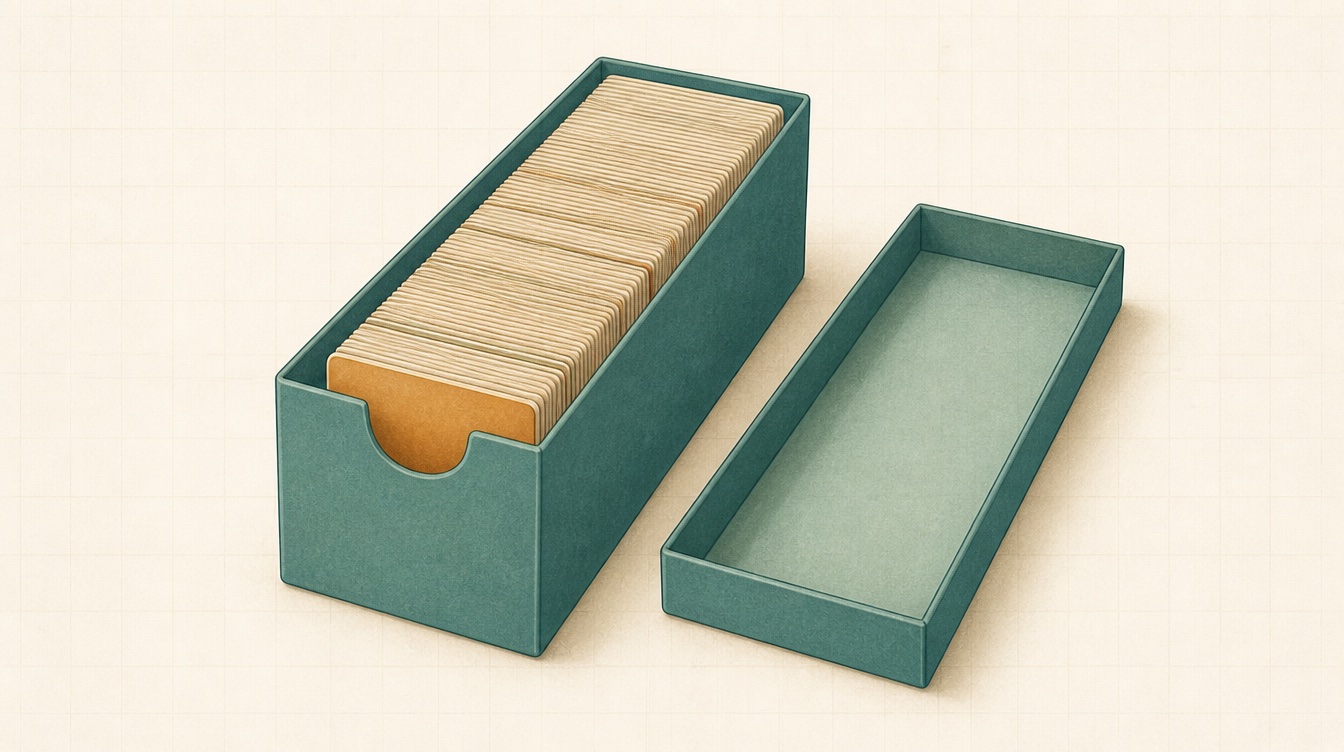
Store true bulk Magic cards unsleeved, standing on edge, in a plain cardboard count box. Whether you write it out as Magic: The Gathering or shorten it to MTG, the storage math doesn't change. That's still the cheapest and most practical answer for a pile of commons you sorted once and don't dig through often. Everything past that first answer is really about figuring out which of your cards have outgrown "bulk" and need a different kind of storage entirely.
The storage ladder
Not every card in a collection belongs at the same tier. Value, not sentiment, should decide where a card lives.
- Unsleeved bulk in a count box. True bulk: commons, low-value cards from years of drafting or opening packs, the stuff you'd never miss individually. A cardboard count box holding cards on edge is the right and cheapest home. We wouldn't spend a cent sleeving this tier.
- Playables, sleeved, in a secure box. Cards actually going into a deck deserve a single sleeve and a box that closes properly, not because they're valuable but because they get handled, shuffled, and carried to games. This is where a deck box earns its cost; see our best deck box for Commander if that's the specific box you're shopping for.
- Binder-worthy cards. Once a card is worth pulling out to look at, trade, or show someone, it belongs flat in a binder page where you can see it, not standing on edge in a box you have to unload to search.
- Graded or slabbed. The cards worth insuring individually. Once a card sits in a hard slab, storage stops being about the card and starts being about the slab: upright, away from a shelf edge it could fall from, out of direct light.
Most collections have cards at every rung of this ladder at once. The mistake is treating them all the same: sleeving cards worth a few cents, or leaving a good pull loose in a shoebox. Worth revisiting the ladder occasionally, too. A card that was bulk two years ago can climb a rung if a reprint dries up or a deck built around it starts winning, and nobody re-sorts a bulk box often enough to catch that on its own.
When cardboard stops being enough
If you want something more durable than cardboard, or you travel with your bulk to game stores and drafts, a handful of oversized deck boxes exist specifically for this. They're a different animal from the single-deck 100-count boxes most players buy for a Commander deck, built instead to hold hundreds to over a thousand cards in one container.
Cardboard's failure mode is slow. Lids wear at the fold, corners round off, and a box that's been pulled on and off a shelf for years eventually starts to sag. None of that happens overnight, so there's no need to rush an upgrade on a box that's still closing flush, even if it looks a little tired. The plastic bulk boxes below solve a different problem: they travel better, they stack squarer on a shelf, and they don't slowly deform the way cardboard does under its own weight over a long enough timeline.
| Box | Double-sleeved | Single-sleeved | Unsleeved |
|---|---|---|---|
| Ultimate Guard Superhive 550+ XenoSkin | 550 | 650 | 1,100 |
| Ultimate Guard Arkhive 400+ XenoSkin | 450 | 500 | 850 |
| Ultimate Guard Arkhive 800+ XenoSkin | 900 | 1,000 | 1,900 |
| Ultimate Guard Omnihive 1000+ XenoSkin | 1,000 | 1,250 | 2,200 |
| Gamegenic Cards' Lair 400+ Convertible | 400 | 540 | not listed |
| Gamegenic Cards' Lair PRO 1000+ Convertible | 1,000 | 1,300 | not listed |
| Vault X Exo-Tec Card Box 450+ | 475 | 575 | 1,000 |
Notice the spread. These aren't scaled-up versions of a Commander deck box; they're a long trunk shape built for volume rather than a single deck's width. Even so, cardboard usually still wins for the pile that lives in a closet and only gets touched once a year. These boxes earn their cost when the bulk moves with you, or when the pile is a specific chunk you actually care about: a set you're building toward, cards pulled aside for eventual sale, something you don't want crushed on a shelf. Browse the full range on our deck boxes page if you're comparing these against the smaller single-deck sizes.
Keep it in the right environment
Wherever the cards live, the room matters more than the container. Keep humidity in the 45 to 55 percent band; too dry and cardboard gets brittle, too humid and cards can warp or the box itself can soften. Keep boxes out of direct sunlight, and out of a garage or attic that swings between temperature extremes across seasons. A closet shelf inside a climate-controlled home beats a more expensive box sitting somewhere the air is working against it.
Common mistakes
- Rubber bands. They dig into the top and bottom cards in a stack over time and leave a permanent indent. A box or a binder does the same holding job without the damage.
- Storing flat stacks instead of cards on edge. A tall flat stack puts weight on the cards at the bottom of the pile. Standing cards on edge in a snug box spreads that weight evenly across corners instead of card faces.
- Packing a box too loosely. Cards that can shift and lean tend to warp at the edges over months. A box that's a little too full holds cards straighter than one with room to slide around, as long as it still closes without force.
- Sleeving cards that don't need it. Sleeving genuine bulk costs more than the cards are worth and doesn't meaningfully improve on standing them upright in a snug box.
- Ignoring the room. A great box in a hot attic still loses to a cardboard box in a stable closet.
- Buying the box before sorting the pile. It's easy to guess wrong on volume and end up either overbuying a 2,200-count box for 400 cards or needing a second box within a month. Sort first, even roughly, then size the container to what you actually have.
- Leaving a grading candidate in the bulk box "for now." A card worth submitting to a grading service takes corner damage sitting loose against a few hundred others while it waits. Pull it the day you decide it's worth grading, not the week you finally get around to shipping it.
A pile of bulk cards isn't a collection you protect card by card. It's a collection you protect by picking the right container and then leaving it alone. Spend your attention on the cards that earned a spot higher up the ladder, and let the cheapest option in the room handle everything else.